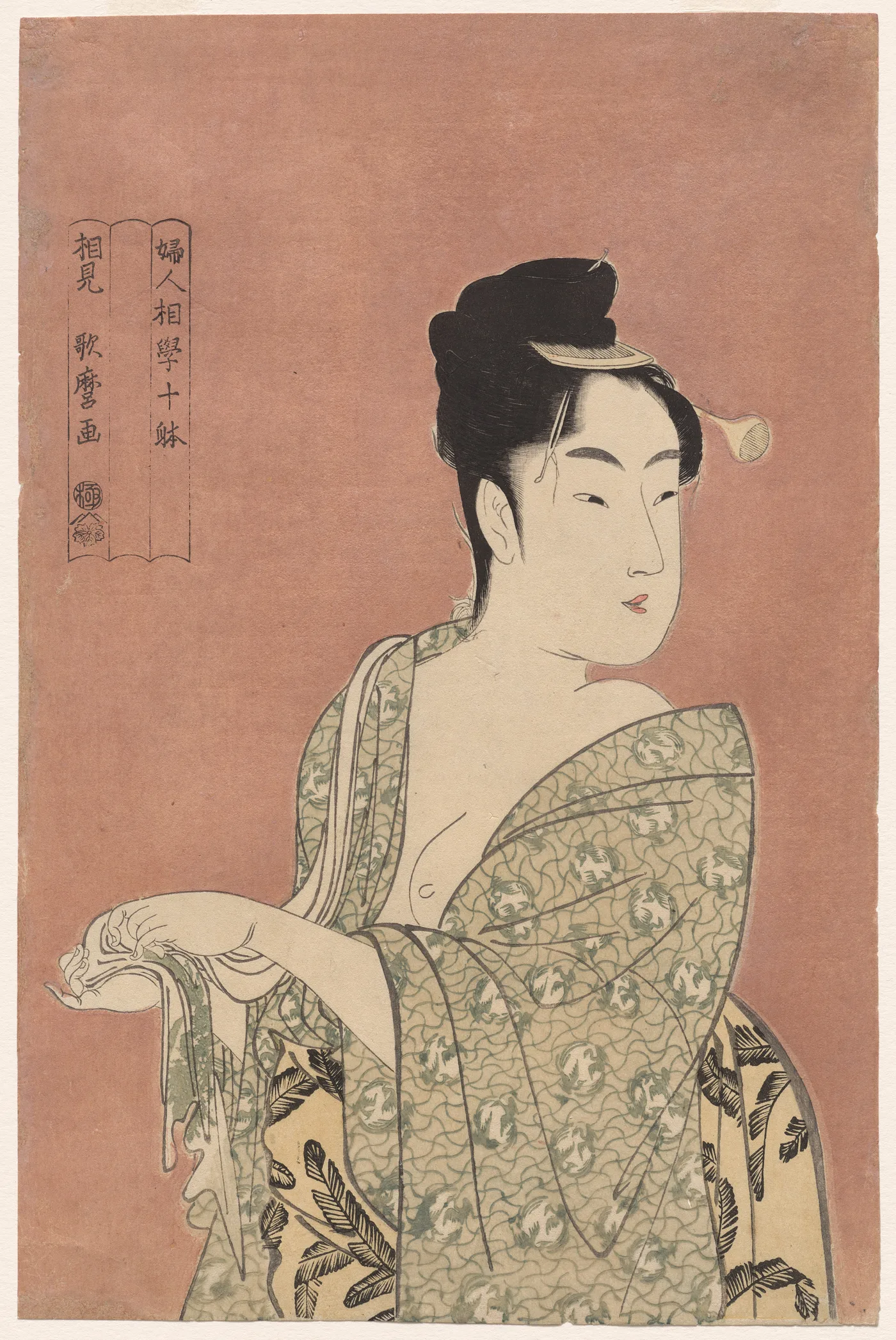
Ten Types in the Physiognomy of Women (The Flirtatious Type) (c. 1792–93)
Kitagawa Utamaro's Ten Types in the Physiognomy of Women, also called Ten Studies in Female Physiognomy, is the series of close-up portraits that made his name in the early 1790s. Its best-known sheet, the Flirtatious Type or Fancy-free Type, shows a woman glancing over her shoulder, her robe slipping off one shoulder. This archive holds the Cleveland Museum of Art's impression, one of only two from the series printed with a pink mica ground.
- Artist
- Kitagawa Utamaro (c. 1753–1806)
- Date
- c. 1793 (Cleveland); 1791–93 (Asia Society); 1792–93 in other references
- Series
- Fujin sōgaku juttai, translated Ten Types in the Physiognomy of Women or Ten Studies in Female Physiognomy
- Publisher
- Tsutaya Jūzaburō, with the censor's seal kiwame
- Signature
- Sōmi Utamaro ga, physiognomy and design by Utamaro
- This archive's prints
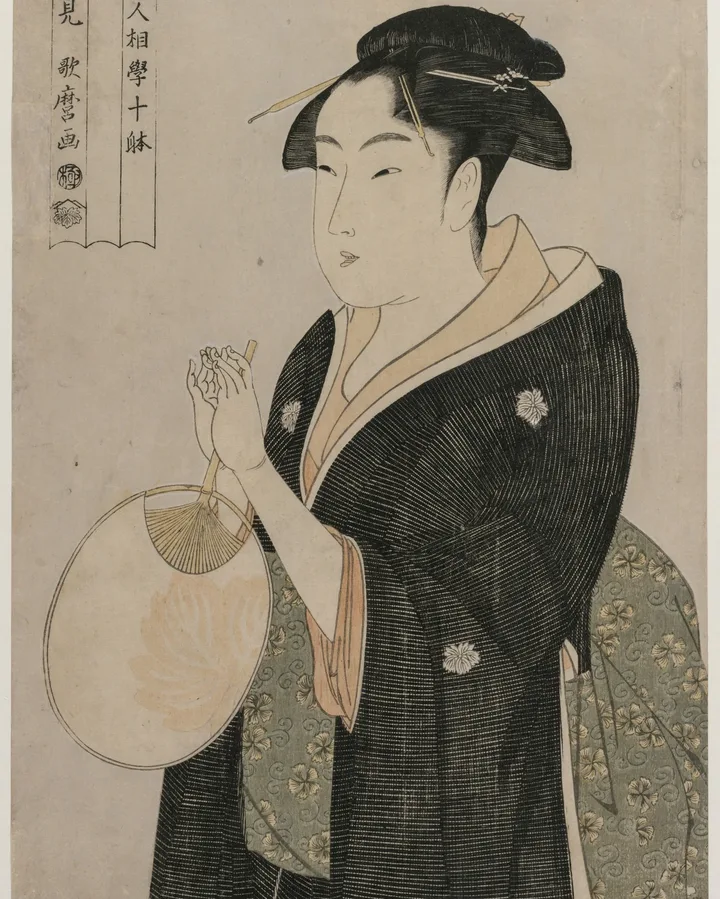
- The Flirtatious Type (1930.218, 36.9 x 25.4 cm) and Woman Holding a Fan (1940.1031) from the same series
- Also known as
- Fujin sōgaku juttai; Ten Studies in Female Physiognomy; Uwaki no sō; The Fancy-free Type; The Light-hearted Type; Utamaro woman with towel
Utamaro and the close-up portrait
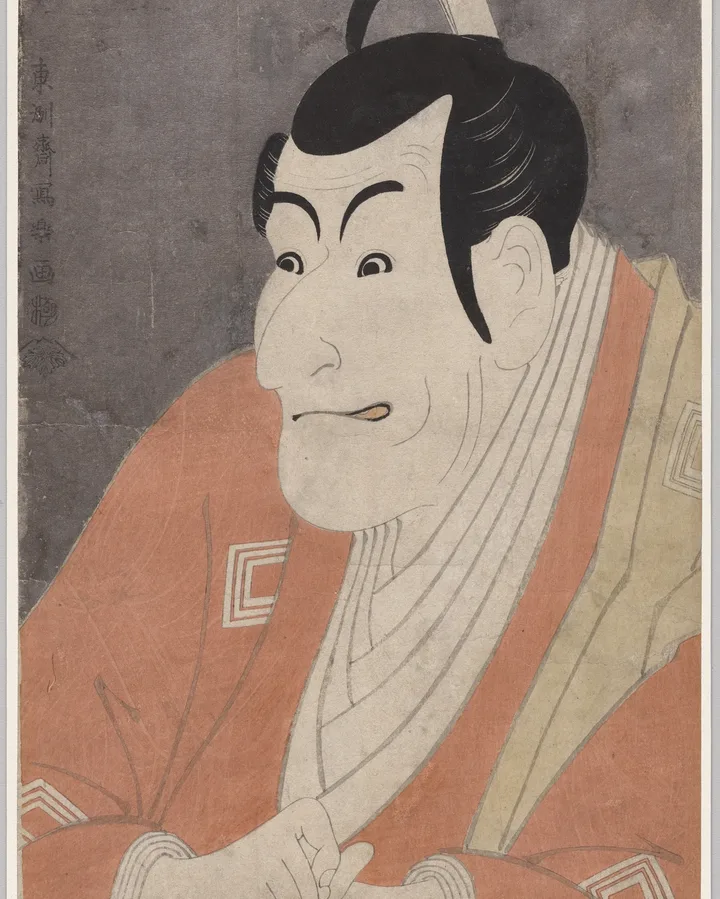
Kitagawa Utamaro was the leading designer of bijinga, pictures of beautiful women, in the 1790s. Little is known of his life. He produced more than two thousand prints, and in 1804, two years before his death, he was manacled for fifty days for making prohibited prints of the sixteenth-century ruler Toyotomi Hideyoshi. He worked closely with the Edo publisher Tsutaya Jūzaburō, who also published Sharaku. The ōkubi-e, the large-head or bust portrait, had been popularized for actor prints by Katsukawa Shunshō and his followers; in the 1790s Utamaro became famous for bust portraits of women. Cropping the figure at the chest let him concentrate on faces, hands, hair and small gestures.
Ten Types in the Physiognomy of Women is one of his best-known series of this kind. Its subject is physiognomy, the old belief that character can be read from the face and body. Utamaro presented himself as the physiognomist: his signature on these sheets reads Sōmi Utamaro ga, which the Cleveland Museum of Art translates as physiognomy and design by Utamaro.
What the Flirtatious Type shows
A young woman turns her head to look over her shoulder. Her light, patterned robe has slipped off one shoulder, and in her hand she holds a cloth. Her hair is pinned up with an ornamented hairpin. The Asia Society describes her expression as alert and searching. The Asia Society, which calls its impression the Light-hearted Type, reads the expression and the careless clothing as signs of a fickle personality who quickly tires and looks for someone new.
The Japanese label, uwaki no sō, has been translated as flirtatious, fancy-free, light-hearted or fickle. These are the series' own playful categories, not descriptions of a real person: the women in these prints are imagined types, and physiognomy itself is not a valid way of judging anyone. What remains striking is how Utamaro uses posture and a few lines of the face to suggest a passing mood.
How it was made
Like other Edo prints, the sheet was printed from several carved blocks: a key block for the fine black outlines of face, hair and robe, and separate blocks for each color and pattern. Utamaro's lines are extremely fine, especially in the hair, where individual strands at the hairline had to be cut in the wood.
The background of the Cleveland impression is a pink ground of mica, a mineral powder that gives a soft shimmer. According to the Cleveland Museum of Art, only two impressions from this series have pink mica, which makes this sheet unusual. Mica dusted into backgrounds for a glittering effect had been popularized in actor prints, and it also appears in Sharaku's first actor portraits of 1794.
Why it became famous
Utamaro was one of the few print designers who became famous across Japan in his own lifetime, and he is still counted among the greatest ukiyo-e artists. Ten Studies in Female Physiognomy is regularly listed among his best-known series. Earlier pictures of beauties tended to repeat the same idealized face; in these portraits Utamaro tried to give each figure an individual manner, and the Flirtatious Type, with its turning pose and open robe, is the image most often reproduced.
The Cleveland impression has a notable history. It belonged to Murata Kinbei of Kanagawa until 1917, passed through Yamanaka and Co., and was bequeathed to the museum in 1930 by the Cleveland collector Edward L. Whittemore. Cleveland's bibliography for it includes Sherman E. Lee's surveys A History of Far Eastern Art and Japanese Decorative Style.
The impressions in this archive
The main image is Cleveland 1930.218, measuring 36.9 x 25.4 cm. Its inscriptions are recorded as the series title, the signature Sōmi Utamaro ga, the censor's seal kiwame and the emblem of the publisher Tsutaya Jūzaburō. In the cartouche at upper left, the series title and signature are printed in two panels, while the narrow middle panel, where the name of the type would go, is empty in this impression; Cleveland catalogues the design by its title, Flirtatious Type.
The archive also holds Woman Holding a Fan from the same series (Cleveland 1940.1031, 34.6 x 24.2 cm), a bequest of James Parmelee. Cleveland records it with the same signature, publisher's emblem and censor's seal. It shows a woman in a dark striped robe holding a round fan, set against a plain pale ground, and makes a useful comparison with the pink-mica Flirtatious Type.
Other versions in the archive
Frequently asked questions
Who made the Flirtatious Type?
Kitagawa Utamaro (c. 1753–1806) designed it for his series Ten Types in the Physiognomy of Women, published by Tsutaya Jūzaburō in the early 1790s.
What does physiognomy mean in Utamaro's series title?
Physiognomy is the old idea that character can be read from appearance. Utamaro signed these prints as a physiognomist, presenting each woman as a personality type. It is a playful premise, not a real science.
Why is the background of the Cleveland print pink?
The ground is printed with pink mica. The Cleveland Museum of Art notes that only two impressions from this series have pink mica.
What is the Japanese title of the Flirtatious Type?
Uwaki no sō, from the series Fujin sōgaku juttai. It is also translated as the Fancy-free Type or the Light-hearted Type.
Who published Utamaro's physiognomy prints?
Tsutaya Jūzaburō, the Edo publisher who championed Utamaro and also published Sharaku. His emblem and the censor's seal kiwame appear on both prints from the series in this archive.