The Fifty-Three Stations of the Tōkaidō (1833–34)
The Fifty-Three Stations of the Tōkaidō is the landscape series that made Utagawa Hiroshige famous: 55 prints of the post towns on the great highway between Edo and Kyoto, published by Hōeidō in about 1833 to 1834. This page is about the series, illustrated with Evening Snow at Kambara and Driving Rain at Shōno, two of its best-known prints, and other Cleveland impressions held in this archive.
- Artist
- Utagawa Hiroshige (1797–1858)
- Date
- c. 1833–34 (Cleveland dates individual sheets 1833 or 1833–34)
- Publisher
- Takenouchi Magohachi (Hōeidō); the first prints were issued jointly with Senkakudō
- Number of prints
- 55: one for each of the 53 stations plus the starting point at Nihonbashi in Edo and the end in Kyoto
- Format
- Color woodblock prints, horizontal ōban
- This archive's main image
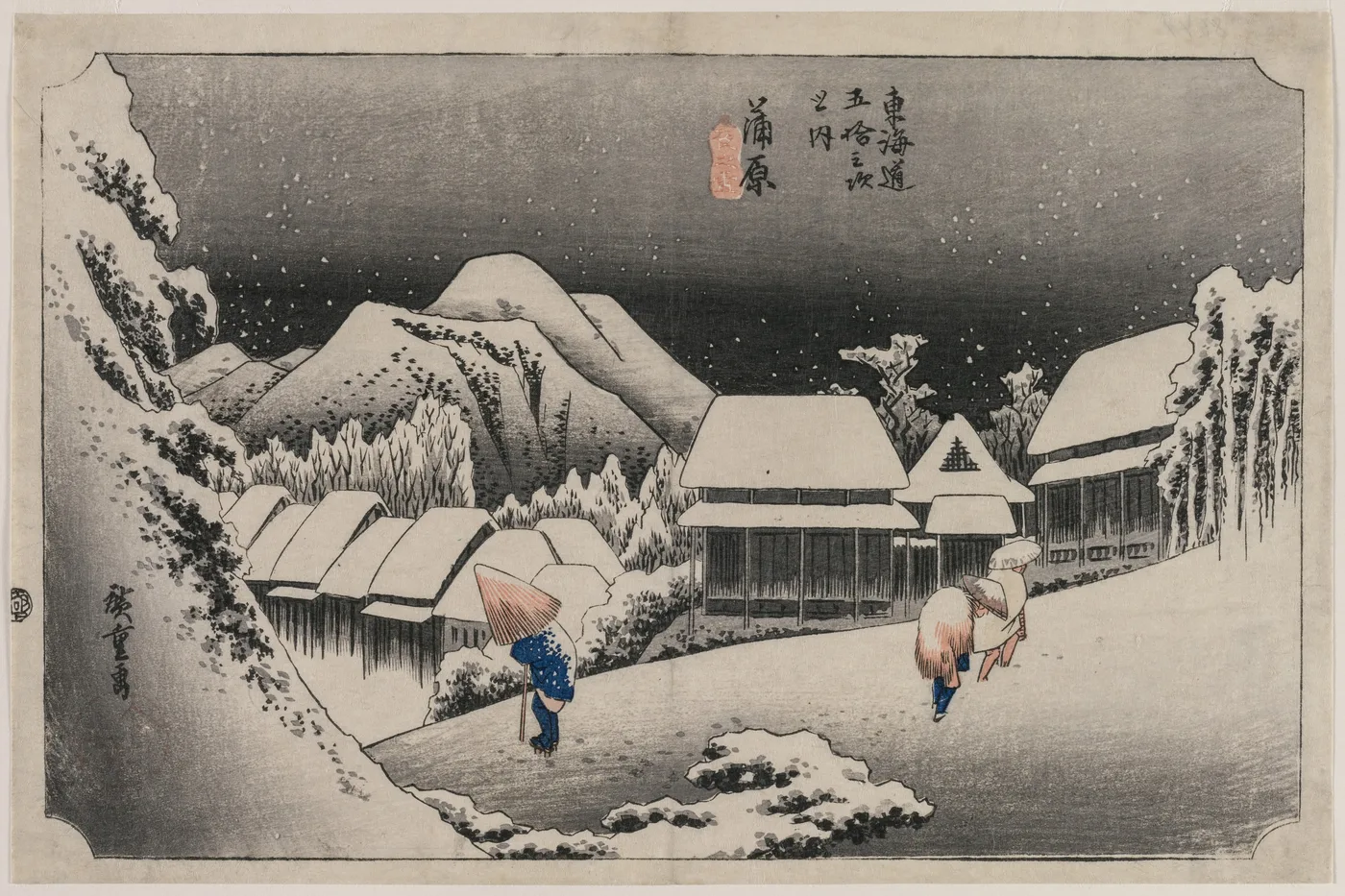
- Evening Snow at Kambara, Cleveland Museum of Art 1985.317, 22.6 x 35.5 cm
- Also known as
- Tōkaidō gojūsan tsugi no uchi; 53 Stations of the Tokaido; Hōeidō Tōkaidō; Evening Snow at Kambara; Driving Rain at Shōno
The road and the journey
The Tōkaidō, or Eastern Sea Road, was the most important highway of Edo-period Japan. It ran along the Pacific coast of Honshū from Edo, the shogun's city, to Kyoto, the imperial capital, and along it stood fifty-three post stations with stables, food and lodging for travelers.
According to reference sources, Utagawa Hiroshige traveled the road in 1832 with an official delegation taking horses from the shogun to the imperial court, sketching along the way. Back in Edo he began the series: one print for each station, plus one for the departure from Nihonbashi bridge in Edo and one for the arrival in Kyoto, 55 in all. Scholars debate whether he saw every view himself, since some designs borrow from an illustrated guidebook of 1797, Tōkaidō meisho zue.
How the prints were made and sold
The series is usually called the Hōeidō edition, after the publisher Takenouchi Magohachi, whose shop was Hōeidō; his name appears on many sheets as Takenouchi. The first prints were issued jointly with another publisher, Senkakudō, and the rest by Hōeidō alone. Hiroshige later designed many other Tōkaidō sets, but this is the one people mean when they speak of his Fifty-Three Stations.
Each sheet was printed from a key block of outlines and separate blocks for each color. The Cleveland Museum of Art notes that three different blocks were needed to print the three shades of grey that suggest distance in the bamboo thicket in Driving Rain at Shōno. Prints like these sold cheaply; reference sources put the price at roughly 12 to 16 copper coins, about the cost of a pair of straw sandals or a bowl of soup.
Evening Snow at Kambara and Driving Rain at Shōno
Evening Snow at Kambara, the sixteenth print in the series (Kambara is the fifteenth station), shows a village buried in snow at night, with three travelers trudging along the road. The Cleveland Museum of Art points out that the coastal town rarely sees snow, and that this may be the first print in which Hiroshige depicted falling snow. The snowflakes are spots carved out of the block, so they print as bare white paper against the grey sky.
Driving Rain at Shōno shows the opposite kind of weather. Travelers and palanquin bearers run up a slope as wind and rain bend a bamboo grove into grey silhouettes. Cleveland notes that the publisher's name, Takenouchi, and part of the series title are written on one of the umbrellas, a small advertisement worked into the picture. Both prints are favorites because Hiroshige turns weather and time of day into the real subject of the scene.
Why the series became famous
The Hōeidō Tōkaidō is described in reference sources as Hiroshige's best-known work and among the best-selling of all Japanese prints. Coming just after Hokusai's Thirty-Six Views of Mount Fuji, it helped establish the landscape print as a major subject and made Hiroshige the leading landscape artist of his time.
Its reputation spread abroad in the late nineteenth and early twentieth centuries. Vincent van Gogh's collection of Japanese prints included sheets from the series, and the architect Frank Lloyd Wright, a keen collector, organized a Hiroshige exhibition at the Art Institute of Chicago in 1906. In Japan the series was famous enough to be parodied: in 1850 Utagawa Kuniyoshi published Cats Suggested as the Fifty-three Stations of the Tōkaidō, replacing each landscape with a cat pun.
The impressions in this archive
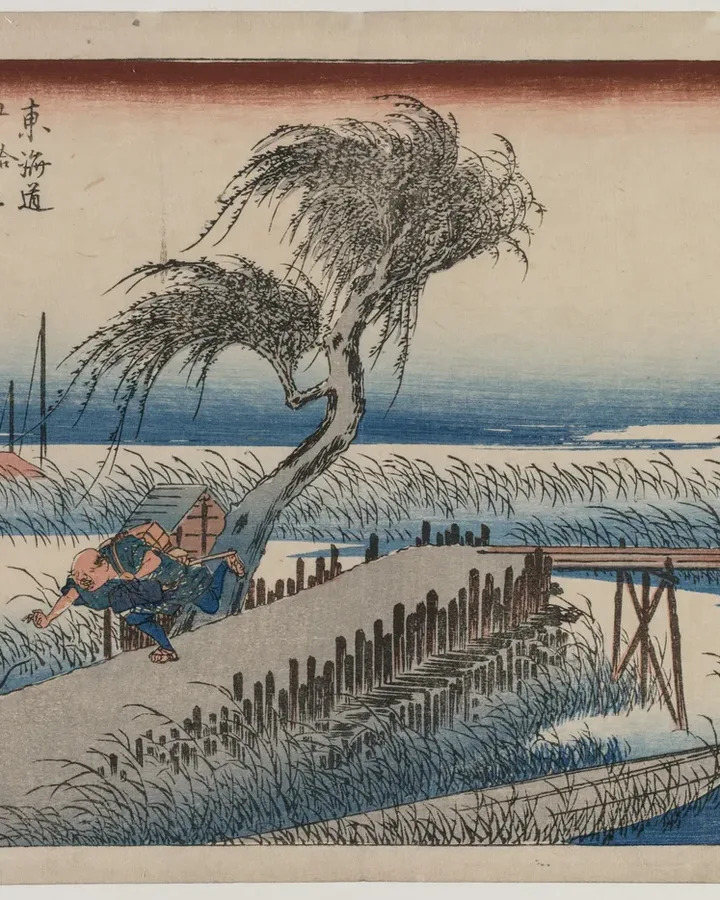
The main image is Cleveland 1985.317, Evening Snow at Kambara, from the Kelvin Smith Collection. It measures 22.6 x 35.5 cm and is recorded with the signature Hiroshige ga, the publisher's seal Takenouchi and the censorship seal kiwame. Its record traces it through a Sotheby Parke Bernet sale in 1975. Driving Rain at Shōno (1948.306) and Yokkaichi: View of the Mie River (1948.307), which Cleveland identifies as coming from Hiroshige's first Tōkaidō series, were given from the collection of Dr. T. Wingate Todd in 1948.
The archive also holds Yahagi Bridge at Okazaki (1916.939), the Tenryū River near Mitsuke (1940.985), the Lake at Hakone (1940.982), Ōtsu (1985.238) and Chiryū (1985.239), all recorded with the Hōeidō or Takenouchi publisher. A second Kambara (1940.984) is catalogued by Cleveland as after Hiroshige, meaning the museum does not treat it as an impression of the original edition; its paper is darkened and the colors faded. Other Tōkaidō prints in the archive, such as Hiroshige's later sets from the 1840s and a Shinagawa by Hiroshige II, belong to different series and are not part of this page.
Other versions in the archive
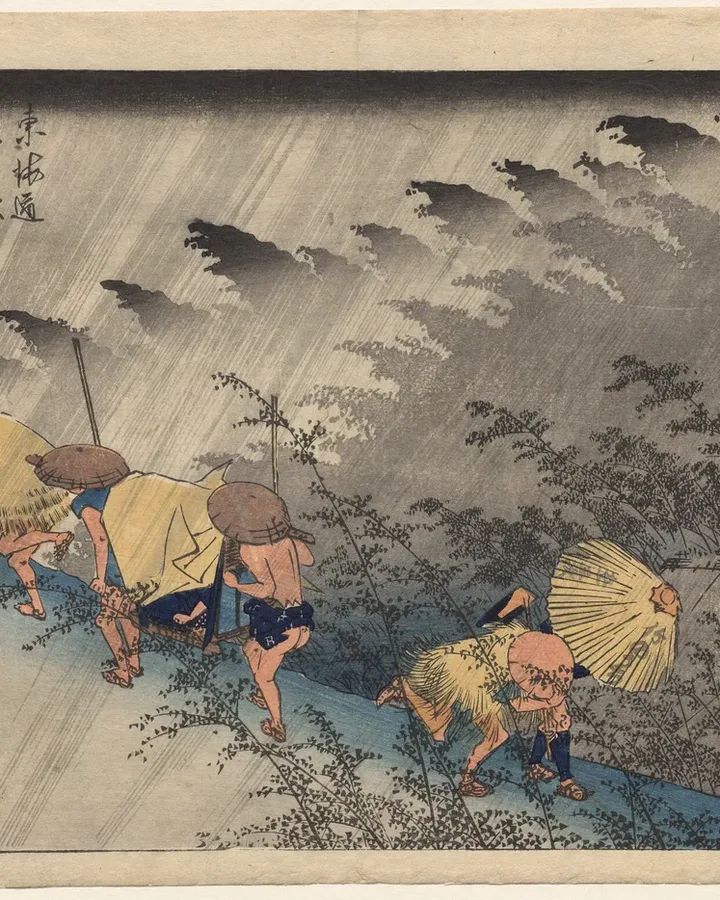
Driving Rain at Shōno, from Fifty-Three Stations of the…
1833
Yokkaichi: View of the Mie River, from the series The…
1833
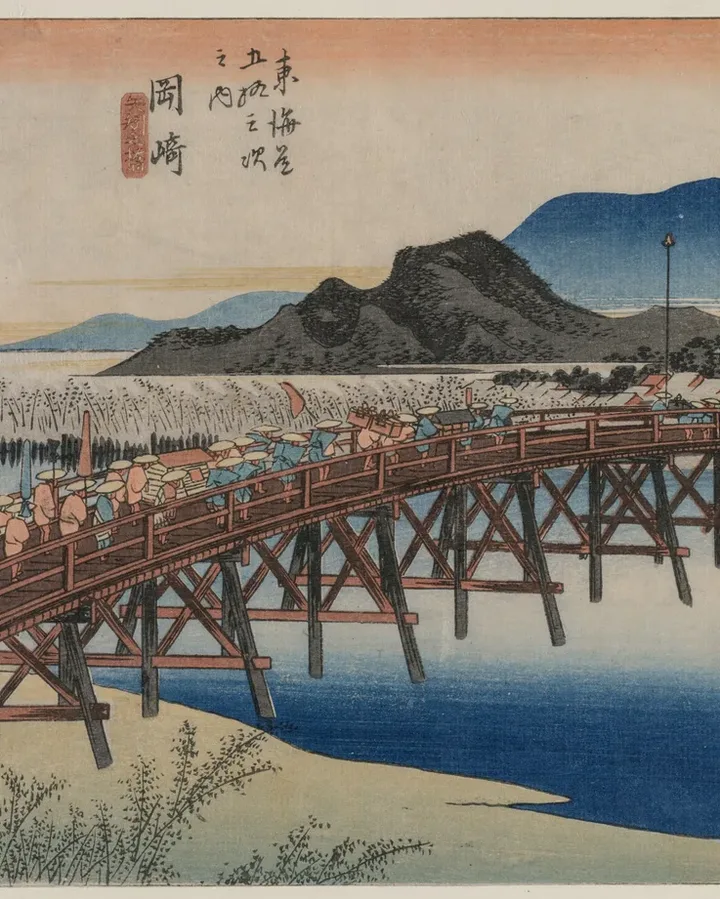
Yahagi Bridge at Okazaki (Station 39), From the series…
1833
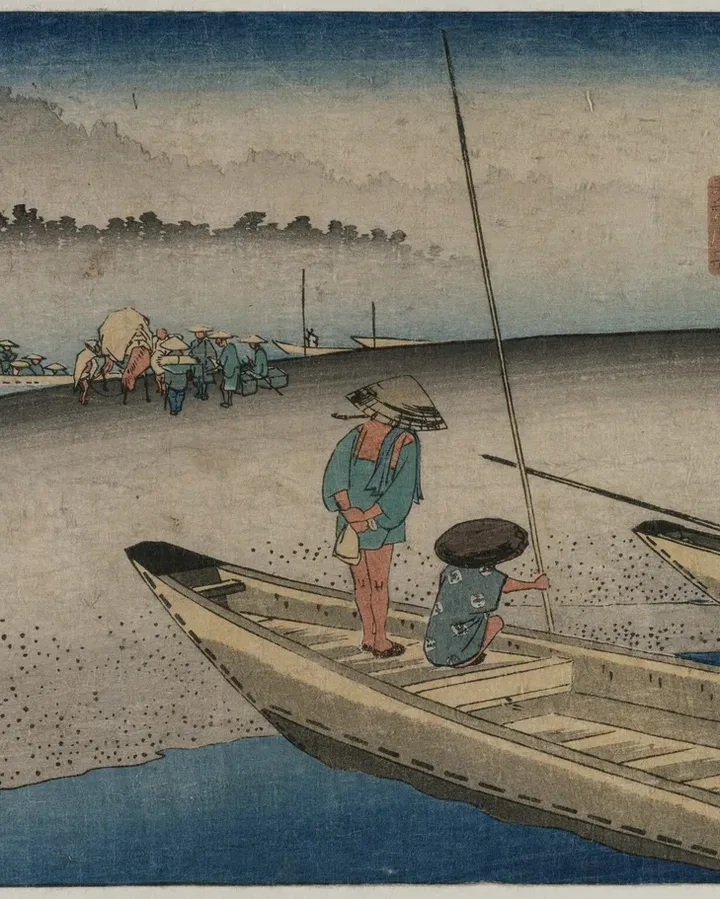
Picture of the Tenryu River near Mitsuke (Station 29), from…
1833
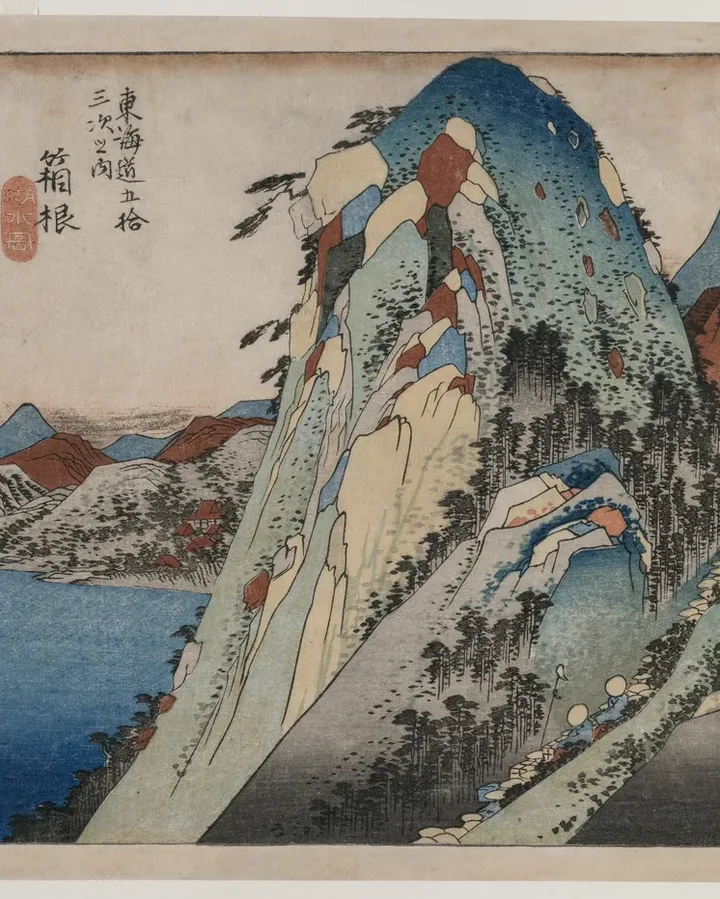
Picture of the Lake at Hakone, from the series 53 Stations…
1833
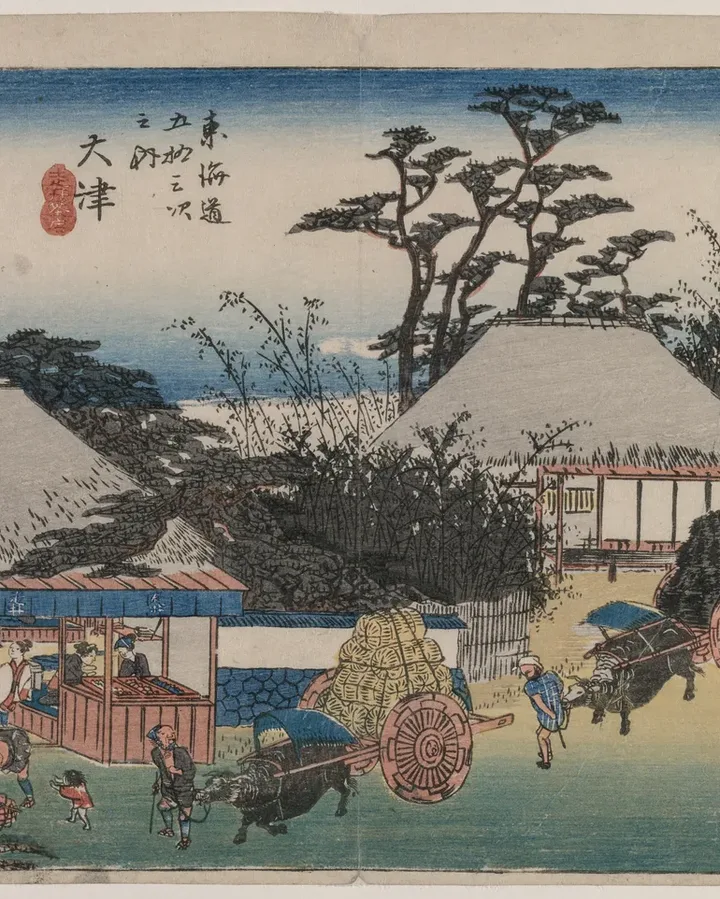
The Fifty-Three Stations of the Tokaido: Otsu
1833
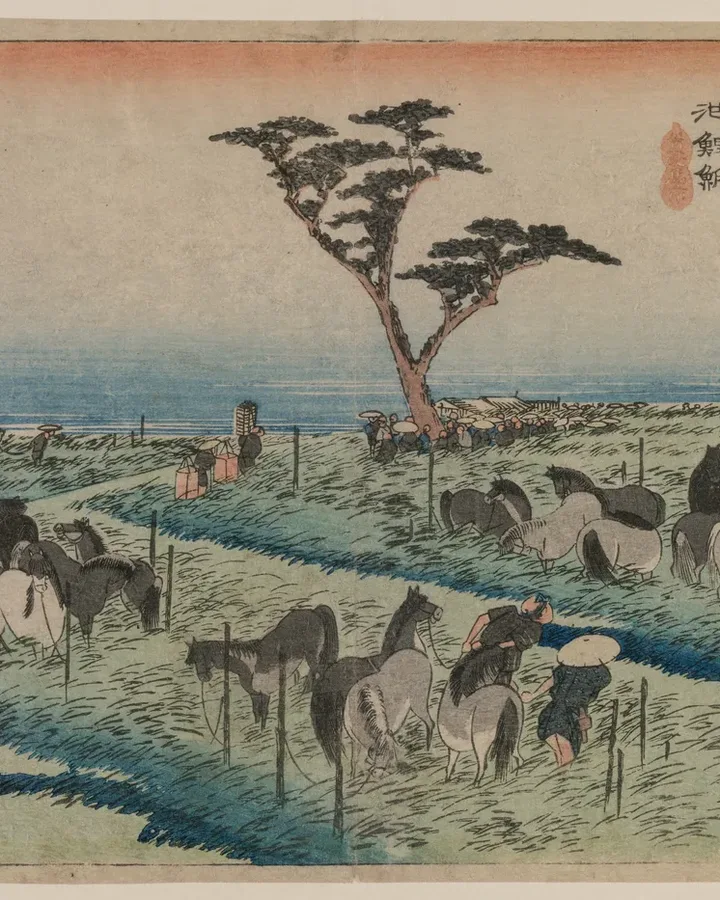
The Fifty-Three Stations of the Tokaido: Chiryu
1833
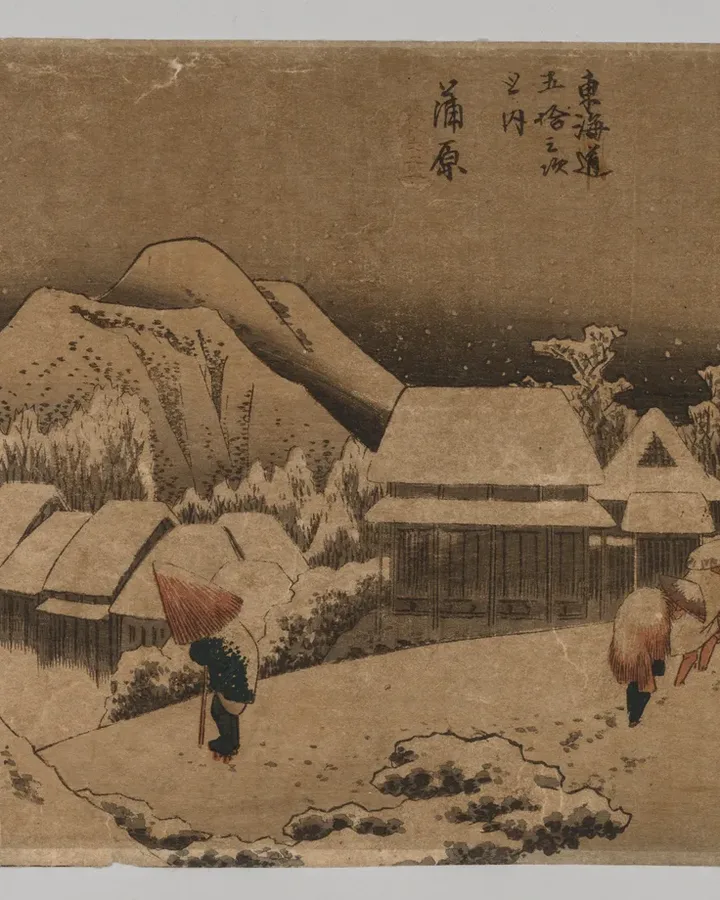
Kambara: Evening Snow
1797
Frequently asked questions
Who made The Fifty-Three Stations of the Tōkaidō?
Utagawa Hiroshige (1797–1858) designed the series. The best-known edition was published by Takenouchi Magohachi (Hōeidō) in about 1833 to 1834.
Why are there 55 prints in the Fifty-Three Stations?
The series has one print for each of the 53 post stations, plus one for the starting point at Nihonbashi in Edo and one for the end of the road in Kyoto.
What is the Tōkaidō?
The Tōkaidō, or Eastern Sea Road, was the main highway of Edo-period Japan, running along the coast between Edo (Tokyo) and Kyoto.
What is the most famous print in Hiroshige's Tōkaidō series?
Evening Snow at Kambara and Driving Rain at Shōno are among the most famous. Both are in this archive.
What does Hōeidō mean?
Hōeidō was the shop name of the publisher Takenouchi Magohachi. Collectors use it to distinguish this first, best-known Tōkaidō series from Hiroshige's many later ones.
Sources
- Cleveland Museum of Art, Evening Snow at Kambara, 1985.317
- Cleveland Museum of Art, Driving Rain at Shōno, 1948.306
- Cleveland Museum of Art, Yokkaichi: View of the Mie River, 1948.307
- Wikipedia, The Fifty-three Stations of the Tōkaidō
- Hood Museum of Art, Kanbara yoru no yuki (Kanbara: Night Snow)
- Cleveland Museum of Art, Kambara: Evening Snow (after Hiroshige), 1940.984