South Wind, Clear Sky (Red Fuji) (c. 1830–32)
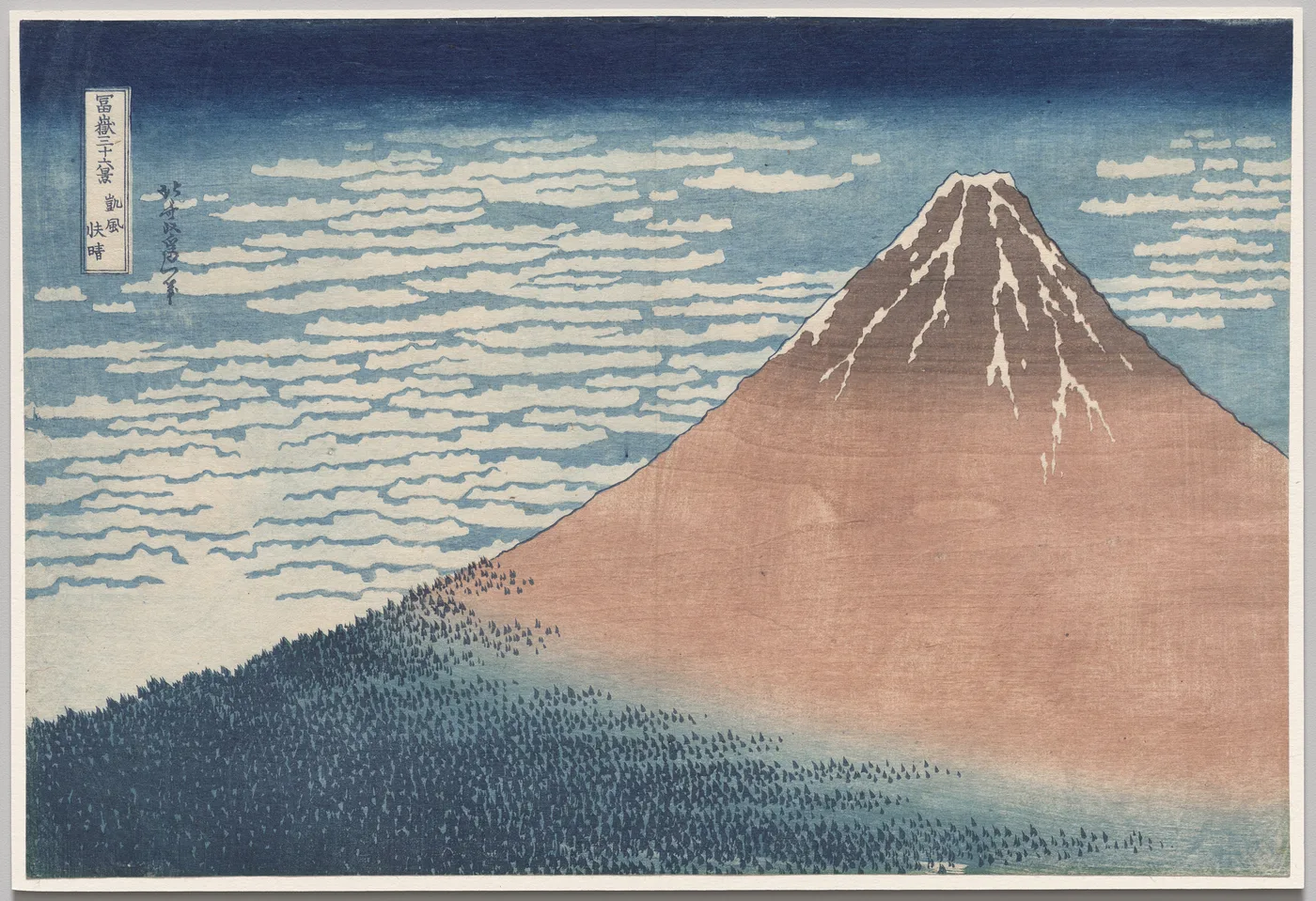
Katsushika Hokusai's South Wind, Clear Sky, better known as Red Fuji or Fine Wind, Clear Morning, shows Mount Fuji alone, its slopes turned red under a sky of rippled clouds. Published in the early 1830s in the series Thirty-Six Views of Mount Fuji, it is one of the simplest and most admired Japanese landscape prints. This archive holds the Cleveland Museum of Art's impression.
- Artist
- Katsushika Hokusai (1760–1849)
- Date
- Early 1830s (Cleveland); c. 1830–32 (Metropolitan Museum of Art)
- Series
- Thirty-Six Views of Mount Fuji (Fugaku sanjūrokkei)
- Japanese title
- Gaifū kaisei, literally south wind, clear sky
- Publisher
- Nishimuraya Yohachi
- This archive's impression
- Cleveland Museum of Art 1930.189, 25.6 x 37.5 cm, Bequest of Edward L. Whittemore
- Also known as
- Red Fuji; Fine Wind, Clear Morning; Gaifū kaisei; Akafuji; Clear Day with a Southern Breeze
One mountain, almost nothing else
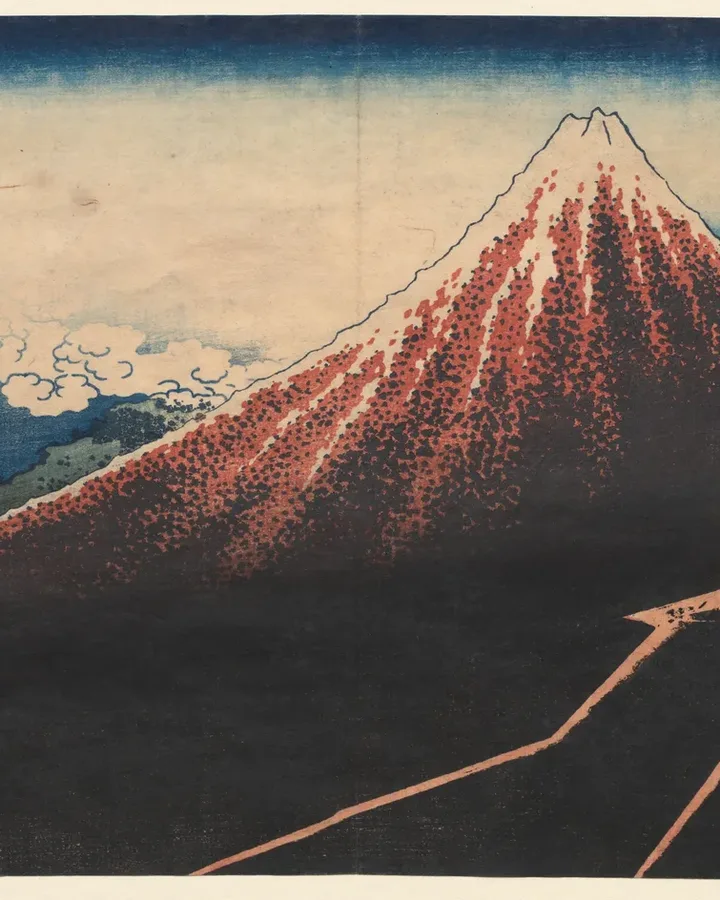
Many prints in Katsushika Hokusai's Thirty-Six Views of Mount Fuji place the mountain behind people at work or on the road. This one leaves people out entirely. The great cone of Fuji fills the right side of the sheet, its upper slopes streaked with the last patches of snow, its lower slopes dark with forest. To the left, rows of small white clouds drift across a blue sky. There is no place name in the title, so the viewpoint has never been identified.
The title, Gaifū kaisei, means roughly south wind, clear sky, and is also translated Fine Wind, Clear Morning or Clear Day with a Southern Breeze. It describes a weather condition rather than a location. The Cleveland Museum of Art explains that the scene belongs to the time between late summer and early autumn, when the mountain takes on a reddish hue; reference sources describe the effect as the rising sun turning Fuji red on a clear morning with a southerly wind.
How it was made
Like every print in the series, Red Fuji was designed by Hokusai and then cut into wooden blocks by a carver and printed by hand, one block for each color, for the publisher Nishimuraya Yohachi. The series was produced in about 1830 to 1832, when Hokusai was in his seventies. The Victoria and Albert Museum notes that it was the first series made up entirely of large-format landscape prints, and that it made heavy use of Prussian blue, a pigment recently introduced to Japan.
The color is laid on in broad, flat areas with soft gradations. The sky deepens from pale blue to dark blue at the top, and the mountain shades from red to a darker tone near the peak. The Cleveland Museum of Art points out one detail of the printing on its own impression: the natural grain of the cherry-wood block printed onto the paper along with the red color, so the wood itself shows in the mountainside.
Why it became famous
Together with The Great Wave off Kanagawa, which opens the same series, Red Fuji is among the most widely recognized Japanese prints in the world. It has been described as one of the simplest and at the same time one of the most outstanding of all Japanese prints. Reference sources note that in Japan it is often esteemed even above the Great Wave, which is better known abroad.
Its appeal lies in how little it uses. A few shapes and three or four colors are enough to give the size of the mountain, the season and the time of day. Impressions are held by major museums including the British Museum, the Metropolitan Museum of Art and the Museum of Fine Arts, Boston, as well as by Cleveland.
What to look for
Notice the balance of the composition. The heavy, symmetrical triangle of the mountain sits to the right, and the delicate pattern of clouds fills the space to the left. The line where forest meets slope runs as a soft, speckled band of dark dots, a printed shorthand for trees. At the top of the slopes, the white snow is simply bare paper left unprinted between the red areas.
In the upper left is a rectangular cartouche with the series title and the print's title, and beside it Hokusai's signature, read on the Cleveland impression as Hokusai aratame Iitsu hitsu, meaning brush of Iitsu, formerly Hokusai. Iitsu was the art name Hokusai was using at this time.
Impressions and the one in this archive
Red Fuji was printed in different color schemes over time, and collectors distinguish them. Reference sources describe the earliest impressions as paler, with an unevenly printed blue sky, and call them Pink Fuji; they are very rare. Later impressions typically have a strong, even blue sky and a deeper red pigment, which gave the print its popular name. There was also an alternative version with a quite different color scheme. Specialist sources do not all describe these stages in the same way, so we give only the broad outline here.
The impression in this archive is Cleveland Museum of Art 1930.189, measuring 25.6 x 37.5 cm. Its record gives the signature Hokusai aratame Iitsu hitsu and the publisher Nishimuraya Yohachi. It was sold by Yamanaka and Co., New York, to the Cleveland collector Edward L. Whittemore, who bequeathed it to the museum in 1930. Cleveland's record does not assign it to a particular printing, so we do not either; in the image the sky is a deep blue at the top and the mountain a soft, salmon red.
Frequently asked questions
Who made Red Fuji?
Red Fuji was designed by Katsushika Hokusai (1760–1849) for his series Thirty-Six Views of Mount Fuji and published by Nishimuraya Yohachi in the early 1830s.
What is the real title of Red Fuji?
The Japanese title is Gaifū kaisei, usually translated South Wind, Clear Sky, Fine Wind, Clear Morning or Clear Day with a Southern Breeze. Red Fuji (Akafuji) is a popular nickname.
Why is Mount Fuji red in the print?
The print shows the mountain in late summer or early autumn, when it can take on a reddish color in clear weather and morning light. Later printings used a strong red pigment that made the effect bolder.
Is Red Fuji part of the same series as the Great Wave?
Yes. Both belong to Hokusai's Thirty-Six Views of Mount Fuji. This archive holds Red Fuji but not the Great Wave.
Where can I see Red Fuji?
Impressions are held by several museums, including the Cleveland Museum of Art, the British Museum, the Metropolitan Museum of Art and the Museum of Fine Arts, Boston. This page shows Cleveland's impression.