Sudden Shower over Shin-Ōhashi Bridge and Atake (1857)
Utagawa Hiroshige's Sudden Shower over Shin-Ōhashi Bridge and Atake shows people hurrying across a wooden bridge in Edo as a summer downpour sweeps over the Sumida River. Published in 1857 in the series One Hundred Famous Views of Edo, it is one of Hiroshige's best-known prints and the design Vincent van Gogh copied in oil in 1887. This archive holds two Cleveland Museum of Art impressions.
- Artist
- Utagawa Hiroshige (1797–1858)
- Date
- 1857 (ninth month, according to the date seal recorded in reference sources)
- Series
- One Hundred Famous Views of Edo (Meisho Edo hyakkei)
- Medium
- Color woodblock print, vertical ōban format
- Publisher
- Uoya Eikichi (Uoei), as recorded on Cleveland impression 1921.318
- This archive's impressions
- Cleveland Museum of Art 1921.318 (35.3 x 23.2 cm, Gift of J. H. Wade) and 1985.318 (Kelvin Smith Collection)
- Also known as
- Ōhashi Atake no yūdachi; Sudden Shower over Ohashi Bridge; Hiroshige rain on the bridge; Bridge in the Rain (the print Van Gogh copied)
What the print shows
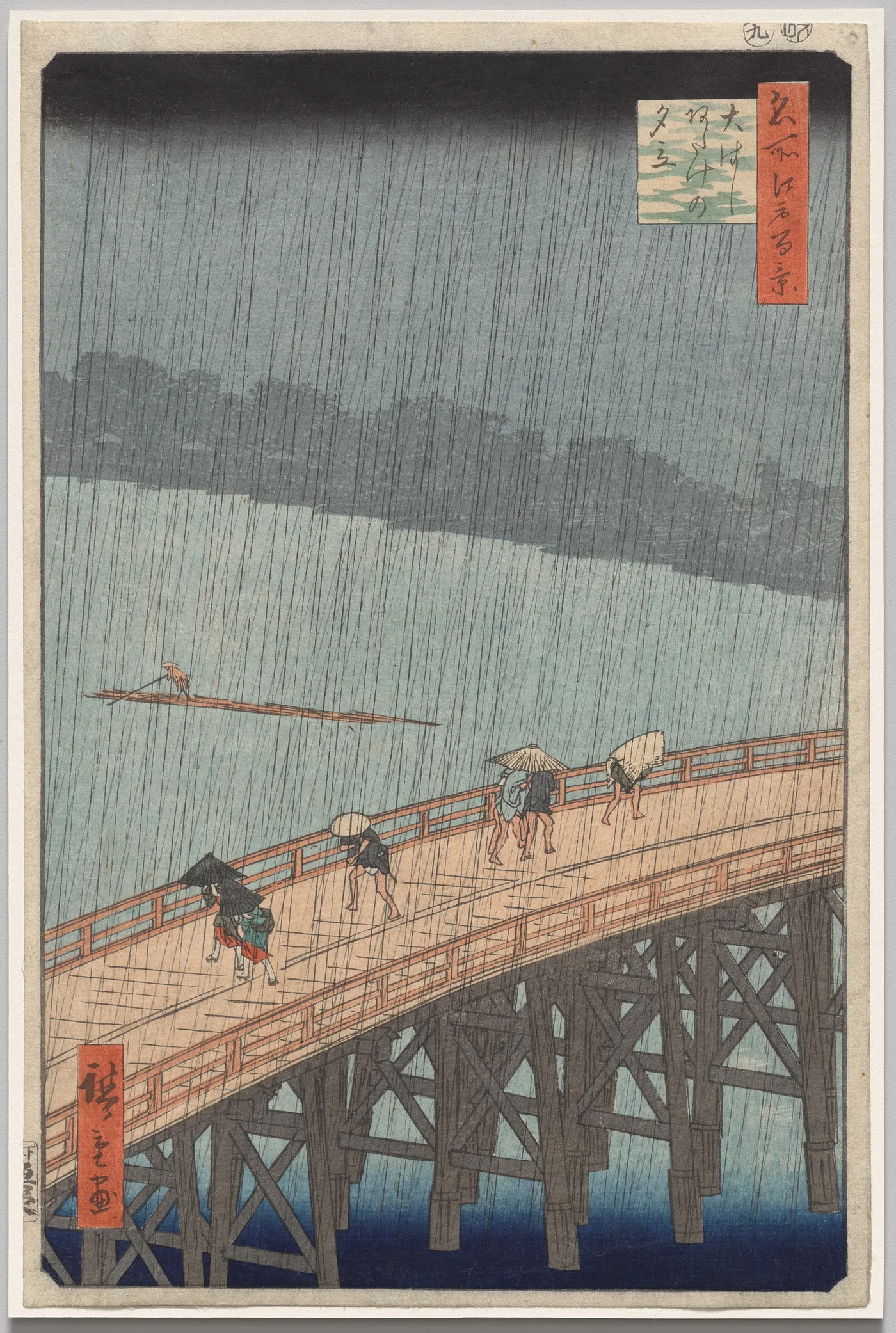
The picture looks down on part of the wooden Shin-Ōhashi, or New Great Bridge, over the Sumida River in Edo, the city now called Tokyo. A sudden shower has caught the people crossing it. Some shelter under umbrellas and wide hats, others under straw capes, and they lean into the rain as they hurry in opposite directions. Below them a lone boatman poles a long log raft across the grey river. On the far bank, almost dissolved by the rain, lies Atake, a district named after the government ship Atakemaru that had once been moored there.
The Cleveland Museum of Art notes that the bridge had been newly rebuilt after the great earthquake and fire that struck Edo in 1855, and that the print was published about a year before Hiroshige's death. The series as a whole was begun soon after that disaster, and many of its views show rebuilt or repaired landmarks of the city.
How the rain was made
Everything in a print like this had to be cut into wood. Hiroshige drew the design, and a specialist carver cut it into a set of cherry-wood blocks, one for the outlines and others for each color. The rain is the boldest part of the design: dozens of fine, dark, parallel lines that fall at two slightly different angles, each one left standing in relief on the block while the wood around it was cut away. Lines this long and thin are hard to carve without breaking.
The black storm cloud at the top was printed with bokashi, a technique in which the printer wipes or graduates the ink on the block so that the tone fades from dark to light. Because bokashi was applied by hand for each sheet, the clouds vary noticeably from one impression to another. Hiroshige's own name for this kind of sudden summer rain, as reported in reference sources, was white rain.
Why it became famous
One Hundred Famous Views of Edo was a large series of 119 prints published in 1856 to 1859, finished after Hiroshige's death by his pupil Hiroshige II. Its views were popular and much reprinted. After Japan opened to foreign trade in the 1850s, prints like these reached Europe, where artists studied their cropped viewpoints, flat areas of color and strong diagonals.
Vincent van Gogh owned and copied Japanese prints. In Paris in October to November 1887 he painted Bridge in the Rain (after Hiroshige), an oil on canvas now in the Van Gogh Museum, Amsterdam. The museum explains that he made the colors more intense than the original and, to keep the proportions of the print on a standard canvas, painted a border around it filled with Japanese characters copied from other prints. That painting has made the bridge design familiar to many people who have never seen a Japanese print.
What to look for
The composition is built on a few strong diagonals. The bridge cuts across the lower half from the lower left, the raft runs the other way across the river, and the rain slants against both. The far bank sits as a pale band of trees, flattened by the rain into a silhouette. There is no horizon in the usual sense; the river simply rises toward the top of the sheet, so the viewer seems to hover above the bridge.
At the upper right are two cartouches: a red one with the series title and a smaller, patterned one with the title of this view. The signature Hiroshige ga appears in a red panel at the lower left. Look closely at the figures, too. Hiroshige gives each one a different gesture, from the walkers bent under umbrellas and wide hats to the figure at the right who has pulled a straw covering over his head.
Versions and the impressions in this archive
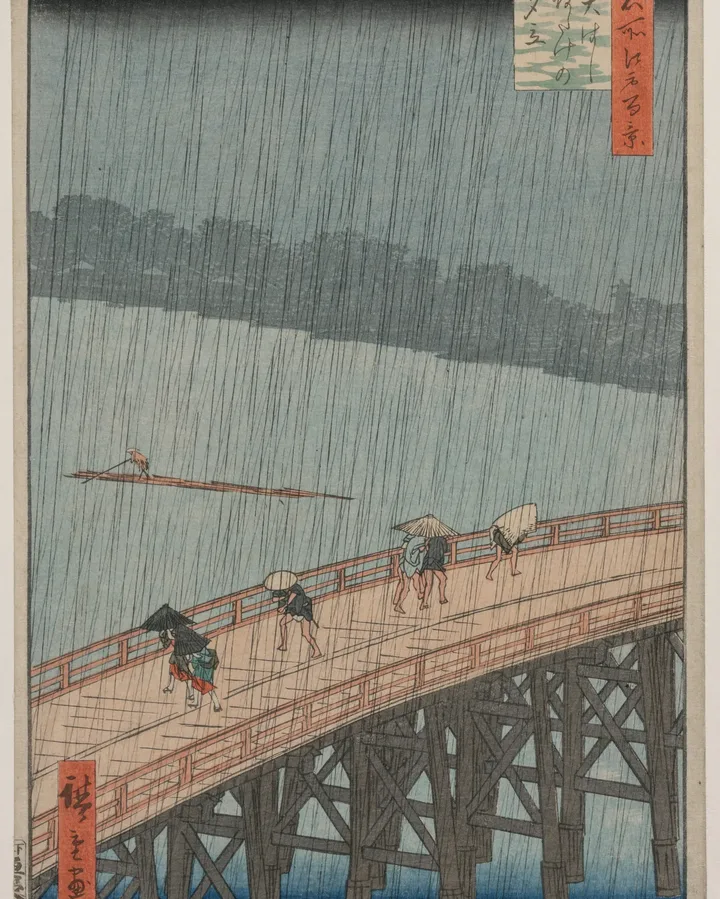
Because popular designs were printed again and again, impressions of Sudden Shower differ. Reference sources note that the earliest printings show two small boats on the far bank that are missing from later ones, that a carving slip in the bridge piles was later corrected, and that later printings add a deep blue gradation under the bridge and a shadow on the walkway. Collectors use details like these to sort early and later impressions.
This archive holds two impressions, both from the Cleveland Museum of Art. The main image is 1921.318, a gift of J. H. Wade, which measures 35.3 x 23.2 cm and is recorded with the signature Hiroshige ga, the publisher Uoya Eikichi and the censorship seal aratame. The second image is 1985.318, from the Kelvin Smith Collection; its record traces it through the Louis W. Black sale at Sotheby Parke Bernet in 1976. Cleveland's records do not say which printing either impression belongs to, and we have not tried to assign one.
Other versions in the archive
Frequently asked questions
Who made Sudden Shower over Shin-Ōhashi Bridge and Atake?
The design is by Utagawa Hiroshige (1797–1858). As with all Japanese woodblock prints of the period, the blocks were cut by a carver and the sheets printed by a printer, working for a publisher.
When was Sudden Shower over Shin-Ōhashi Bridge made?
It was published in 1857 as part of One Hundred Famous Views of Edo. Reference sources give the ninth month of 1857 from the print's date seal.
Did Van Gogh copy Hiroshige's Sudden Shower?
Yes. Van Gogh painted Bridge in the Rain (after Hiroshige) in Paris in October to November 1887. It is in the Van Gogh Museum, Amsterdam, which notes that he intensified the colors and added a border of Japanese characters copied from other prints.
Where is Shin-Ōhashi Bridge?
It crossed the Sumida River in Edo, today's Tokyo. Atake, seen on the far bank in the print, was the area named after the government ship Atakemaru.
Why are there different versions of this print?
Popular designs were reprinted many times from the same or recut blocks, and hand-applied color gradations varied. Later printings differ from the earliest in details such as boats on the far bank and the shading under the bridge.
Sources
- Cleveland Museum of Art, Sudden Shower over Shin-Ōhashi Bridge and Atake, 1921.318
- Cleveland Museum of Art, Sudden Shower over Shin-Ōhashi Bridge and Atake, 1985.318
- Wikipedia, Sudden Shower over Shin-Ōhashi Bridge and Atake
- Van Gogh Museum, Bridge in the Rain (after Hiroshige)
- Victoria and Albert Museum, Sudden Shower over Shin-Ōhashi Bridge and Atake
- Wikipedia, One Hundred Famous Views of Edo