One Hundred Famous Views of Edo (1856–59)
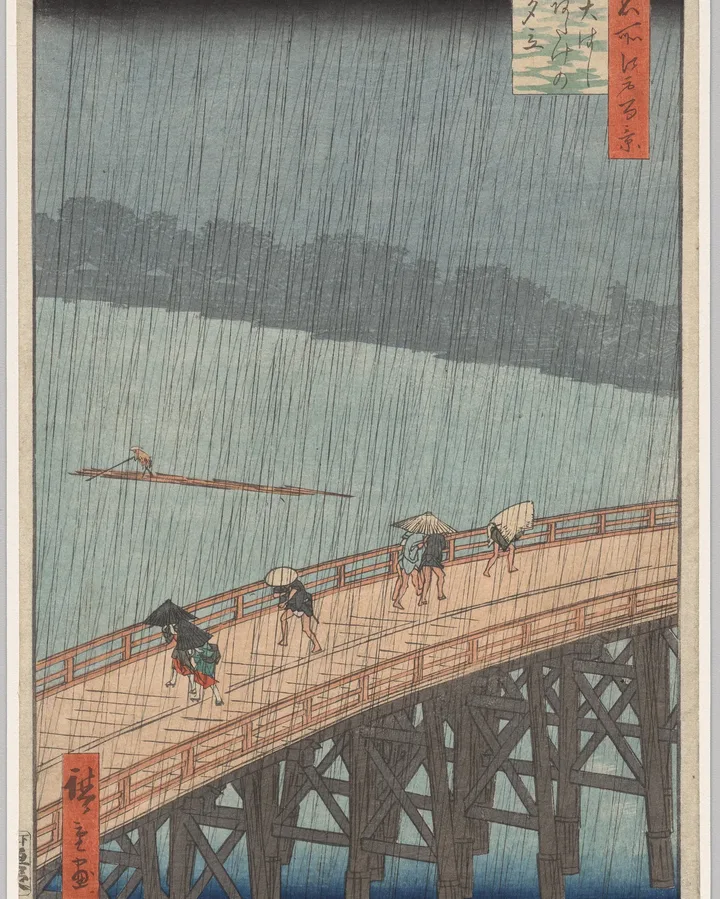
One Hundred Famous Views of Edo was Utagawa Hiroshige's last great series: 119 vertical prints of the city now called Tokyo, published from 1856 to 1859 and completed after his death by Hiroshige II. This page is about the series, illustrated with Fireworks at Ryōgoku and three other Cleveland impressions held in this archive. Its most famous print, Sudden Shower over Shin-Ōhashi Bridge and Atake, has its own page.
- Artist
- Utagawa Hiroshige (1797–1858); completed by Hiroshige II
- Date
- 1856–59
- Number of prints
- 119, despite the title
- Publisher
- Uoya Eikichi (Uoei), as recorded on Cleveland impressions
- Format
- Color woodblock prints, vertical ōban
- This archive's main image
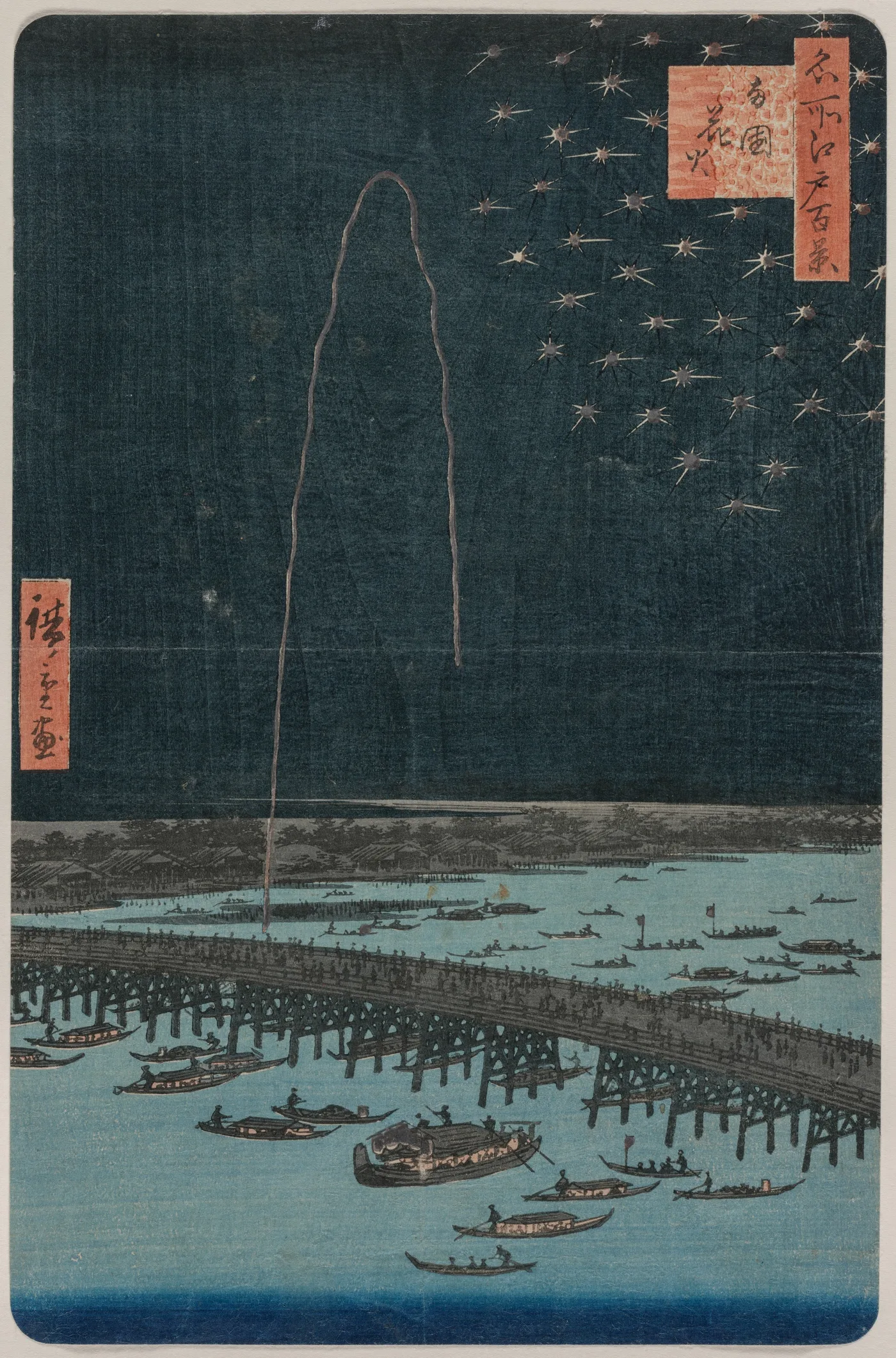
- Fireworks at Ryōgoku, Cleveland Museum of Art 1940.986, 1858
- Also known as
- Meisho Edo hyakkei; One Hundred Views of Famous Places in Edo; Hiroshige 100 Views of Edo; Fireworks at Ryōgoku
A portrait of a rebuilt city
In 1855 a great earthquake and the fires that followed devastated Edo. Soon afterward Utagawa Hiroshige began a series of views of the city's famous places: temples and shrines, bridges and riverbanks, shops, gardens and festivals. Reference sources note that many prints show newly rebuilt or repaired landmarks, and suggest the series may have celebrated, or drawn attention to, the city's recovery.
The prints came out in installments from 1856. Hiroshige died in 1858, and his pupil Hiroshige II finished the set, which grew to 119 prints, far more separate views of one city than any earlier series. For many of his subjects Hiroshige drew on a seven-volume illustrated guidebook, Pictures of Famous Places of Edo (Edo meisho zue), published from 1829 to 1836.
How the prints were designed
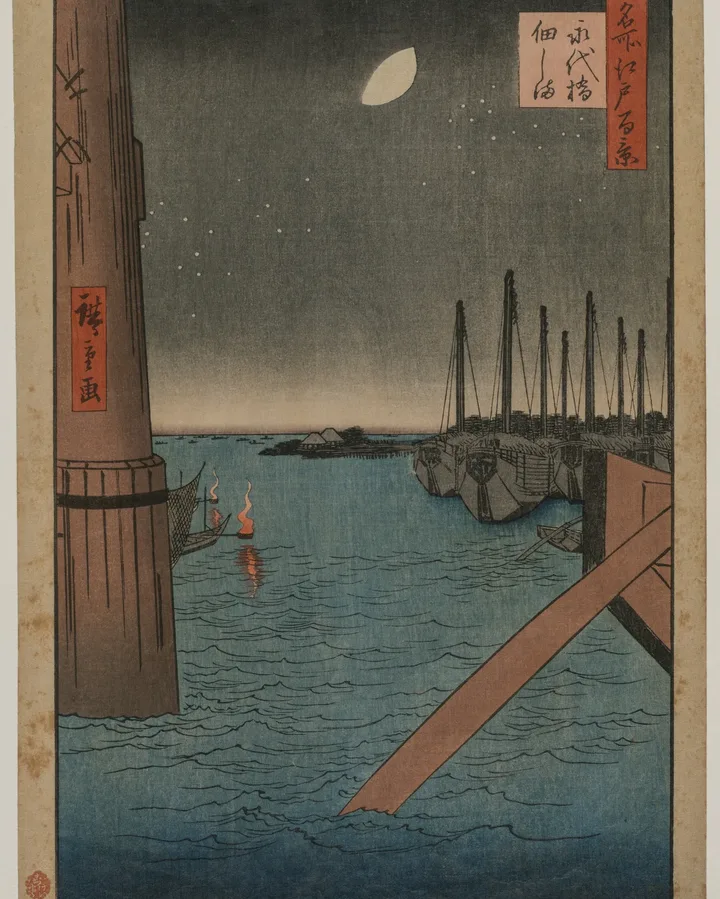
Unlike his Tōkaidō landscapes, these prints are vertical, a format Hiroshige had used in his preceding series of views of the provinces. He exploited the tall sheet with daring compositions: a huge object in the foreground, such as a branch, a boat's oar or a lantern, and the famous place small in the distance behind it. The Cleveland Museum of Art points this out in Tsukudajima from Eitai Bridge, where the island named in the title is tiny and far away, and the oar of a passing boat dominates the view.
Each sheet carries the series title in a red cartouche and the title of the view in a smaller panel, usually at the upper right. Cleveland's impressions record the signature Hiroshige ga, the publisher Uoya Eikichi and the censorship seal aratame, though on some sheets these marks have been trimmed. As with all prints of the period, artist, carver and printer worked to the instructions of the publisher, and the publisher's ownership of the carved blocks was the closest thing to copyright that existed.
Fireworks at Ryōgoku
The archive's main image for this page is Fireworks at Ryōgoku (Cleveland 1940.986), dated 1858. The Ryōgoku Bridge crossed the Sumida River between busy districts of Edo, and was a favorite subject of Hiroshige's. Here, as the Cleveland Museum of Art notes, he gives nearly half the composition to the night sky glittering with fireworks.
Cleveland explains that restaurants and other businesses along the river often sponsored such displays in the 1850s, and that crowds gathered on the bridge, along the shore, in teahouses and on rented pleasure boats to watch. In the print, the long bridge and dozens of small boats crowd the river at the bottom, a single rocket trail climbs into the dark sky, and starbursts scatter across the top of the sheet. This impression measures 33.7 x 22 cm and came to the museum in 1940 in the bequest of James Parmelee. Its record notes that the publisher's mark and censorship seal are trimmed, so the sheet has lost part of its original margin.
Other views from the series in this archive
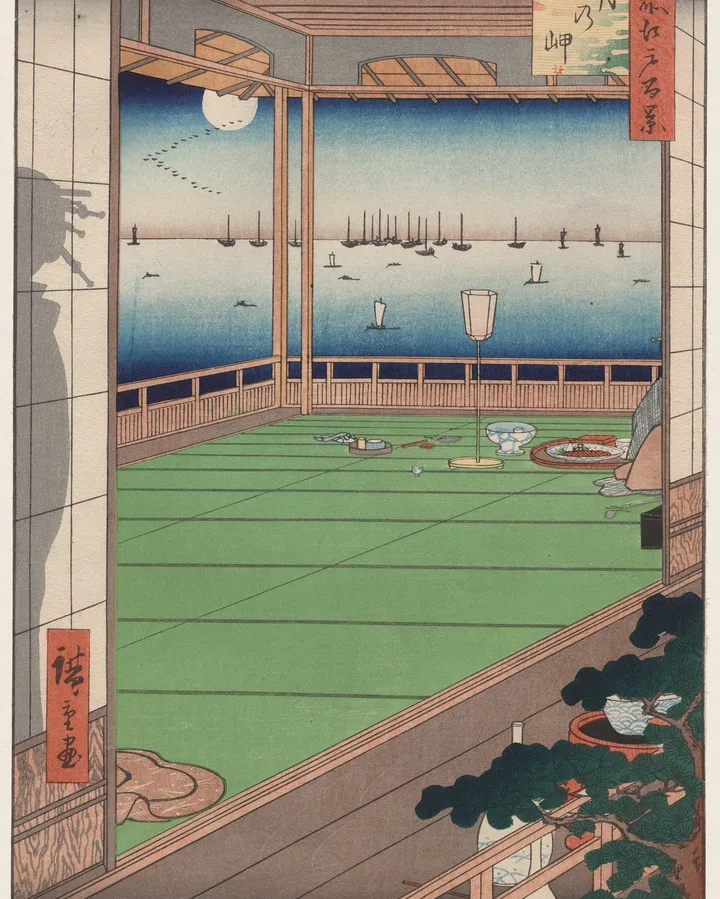
The Moon-Viewing Promontory (Cleveland 1985.320, 1857) looks past pine trees into a room at the end of a moon-viewing party. As Cleveland describes it, the silhouette of a figure with an elaborate hairstyle is visible through a translucent paper door, only the hem of a robe trailing into view, while ships lie at anchor in Edo Bay under the autumn moon. This impression belonged to the French collector Henri Vever and later entered the Kelvin Smith Collection.
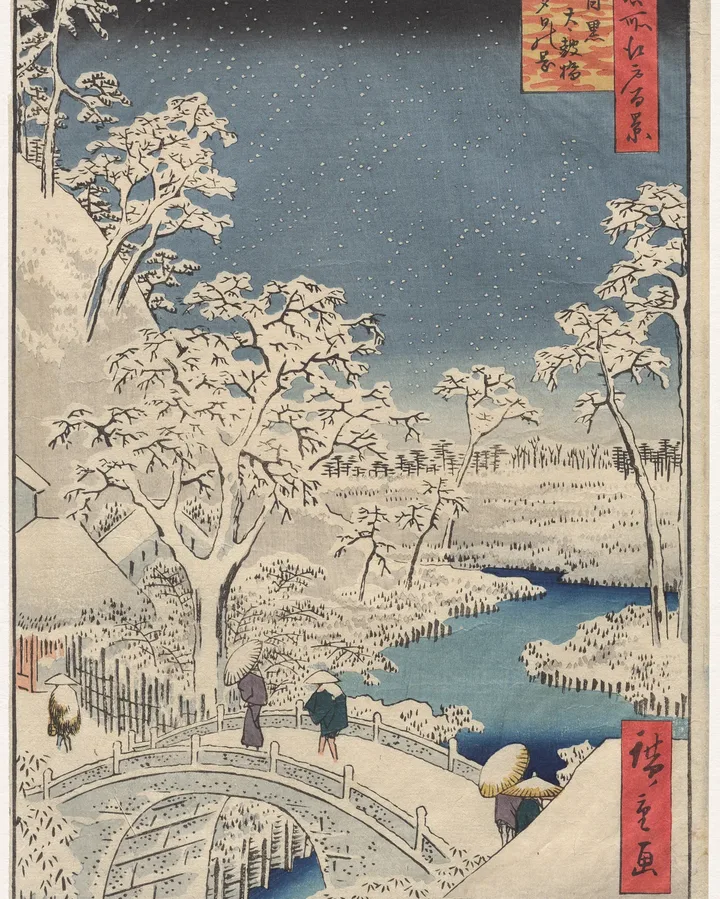
Meguro Drum Bridge and Sunset Hill (Cleveland 1924.971, 1857) shows people crossing an arched stone bridge in falling snow; Cleveland notes the roof of a shop selling sweet red-bean soup with rice cakes in the foreground. Tsukudajima from Eitai Bridge (Cleveland 1992.73, 1858) shows moored ships and torch-lit fishing boats under a starry sky. Sudden Shower over Shin-Ōhashi Bridge and Atake, the best known print of all, is covered on its own page.
Why the series became famous
One Hundred Famous Views of Edo was popular from the start and much reprinted. After Japan opened to foreign trade in the 1850s, prints from the series reached Europe, where artists studied their cropped compositions and bold foregrounds. Vincent van Gogh painted copies of two of them in 1887: Plum Park in Kameido and Sudden Shower over Shin-Ōhashi Bridge and Atake.
For readers today the series is also a record of a city that has largely disappeared. Its bridges, riverbanks, gardens and festivals show Edo in the last years of the shogunate, seen through the eyes of its most popular landscape artist.
Other versions in the archive
Frequently asked questions
How many prints are in One Hundred Famous Views of Edo?
There are 119, not 100. The series was published from 1856 to 1859 and finished by Hiroshige II after Utagawa Hiroshige's death in 1858.
What is the most famous print in One Hundred Famous Views of Edo?
Sudden Shower over Shin-Ōhashi Bridge and Atake, which Van Gogh copied, is the best known. Plum Park in Kameido, also copied by Van Gogh, is another.
Why did Hiroshige make One Hundred Famous Views of Edo?
The series began soon after the 1855 Edo earthquake and fires, and many prints show rebuilt landmarks. It celebrated the city's famous places across the seasons.
Who finished One Hundred Famous Views of Edo?
Utagawa Hiroshige died in 1858 before the series was complete. His pupil Hiroshige II finished it, and the last prints appeared in 1859.
Is it called One Hundred Famous Views of Edo or One Hundred Views of Famous Places in Edo?
Both are translations of the Japanese title Meisho Edo hyakkei. Museums use either; the Cleveland Museum of Art uses both on different records.
Sources
- Wikipedia, One Hundred Famous Views of Edo
- Cleveland Museum of Art, Fireworks at Ryōgoku, 1940.986
- Cleveland Museum of Art, The Moon-Viewing Promontory, 1985.320
- Cleveland Museum of Art, Meguro Drum Bridge and Sunset Hill, 1924.971
- Cleveland Museum of Art, Tsukudajima from Eitai Bridge, 1992.73
- Wikipedia, Sudden Shower over Shin-Ōhashi Bridge and Atake
More famous works by Ukiyo-e
Sudden Shower over Shin-Ōhashi Bridge and Atake
1857
South Wind, Clear Sky (Red Fuji)
c. 1830–32
Sharaku's Kabuki Actor Prints (1794)
1794
Thirty-Six Views of Mount Fuji
c. 1830–32
The Fifty-Three Stations of the Tōkaidō
1833–34
Ten Types in the Physiognomy of Women (The Flirtatious Type)
c. 1792–93