Thirty-Six Views of Mount Fuji (c. 1830–32)
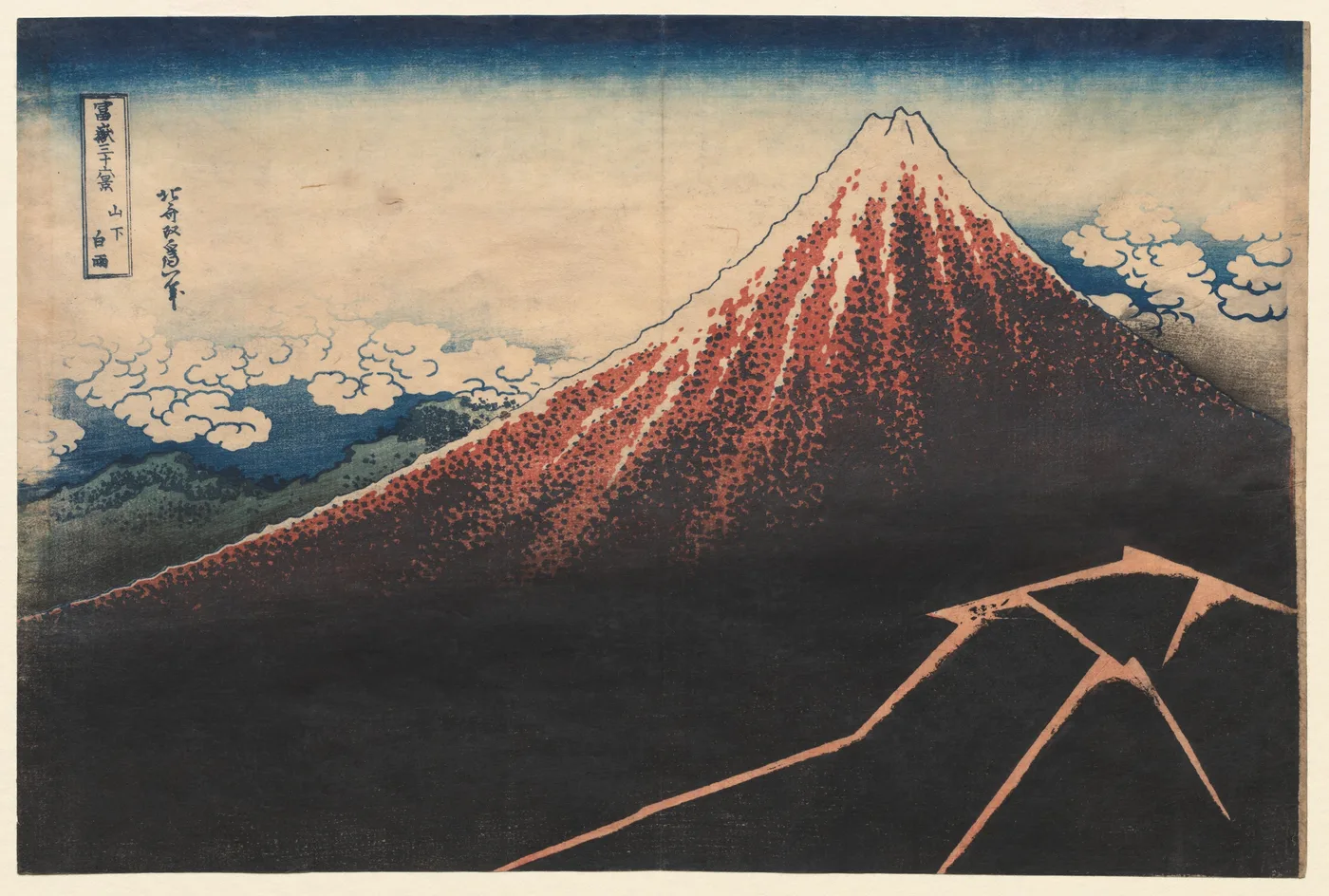
Thirty-Six Views of Mount Fuji is the landscape print series Katsushika Hokusai designed around 1830 to 1832, the set that includes the Great Wave and Red Fuji. It was so successful that ten more views were added. This page is about the series; it is illustrated with Rain Below the Mountain, often called Thunderstorm Beneath the Summit or Black Fuji, and two other Cleveland impressions from the set held in this archive.
- Artist
- Katsushika Hokusai (1760–1849)
- Date
- c. 1830–32 (Cleveland dates its impressions to the early 1830s)
- Publisher
- Nishimuraya Yohachi (Nishimura Eijudō)
- Number of prints
- 46: the original thirty-six plus ten added after the series succeeded
- Format
- Color woodblock prints, horizontal ōban
- This archive's prints
- Rain Below the Mountain (1940.1002), The Surface of Lake Misaka in Kai Province (1985.325), The Weir at Senju in Musashi Province (1924.964); Red Fuji has its own page
- Also known as
- Fugaku sanjūrokkei; Hokusai 36 Views of Mount Fuji; Rain Below the Mountain; Thunderstorm Beneath the Summit; Black Fuji
A series about one mountain
Mount Fuji, Japan's highest mountain, had long been a sacred and literary subject, linked in legend with the elixir of immortality. By Hokusai's day it was also a familiar sight from the roads and waterways around Edo. The Cleveland Museum of Art notes that travel books of the time sometimes marked the best places to see it.
Katsushika Hokusai, then in his seventies, designed Thirty-Six Views of Mount Fuji for the publisher Nishimuraya Yohachi in about 1830 to 1832. Each print shows the mountain from a different place, season or kind of weather, often small in the distance behind people going about their work. The publisher added ten more designs after the first ones sold well, making forty-six in all; reference sources say Nishimura had planned more than a hundred, but publication stopped at forty-six. The Victoria and Albert Museum describes it as the first series made up entirely of large-format landscape prints.
How the prints were made
Hokusai's drawing for each design was glued onto a block of wood to guide the carver, so the original drawing was destroyed in the cutting. A separate block was cut for each color, and the printer applied water-based color to each block in turn.
The series made heavy use of Prussian blue, a synthetic pigment recently brought to Japan from Europe. Reference sources note that the earliest prints were dominated by blue, including blue outlines, and that once the publisher was sure of success, fuller color schemes followed. Many designs were reprinted for years, so impressions vary in color and condition.
Rain Below the Mountain
The archive's main image for this page is Rain Below the Mountain (Sanka hakuu), also known as Thunderstorm Beneath the Summit, Rainstorm Beneath the Summit or Black Fuji. It is one of the most famous prints in the series. Fuji fills the sheet as in Red Fuji, but the mood is reversed. The peak is lit and dotted with red, clouds billow around the upper slopes, and the whole base of the mountain is plunged into darkness, split by a zigzag of lightning.
The Cleveland Museum of Art suggests that Hokusai probably composed it as a complement to South Wind, Clear Sky, to show the mountain's majesty in different weather: here a sudden shower covers the base and lower slopes. Reference sources add that later printings changed the design, with a purplish sky, a yellow band at the top and a new block of pine trees lit by the lightning at the foot of the mountain. Cleveland's impression, 1940.1002, shows no pine trees and a blue sky with white clouds; its record lists the signature Hokusai aratame Iitsu hitsu and does not assign the sheet to a particular printing.
Lake Misaka and the Weir at Senju
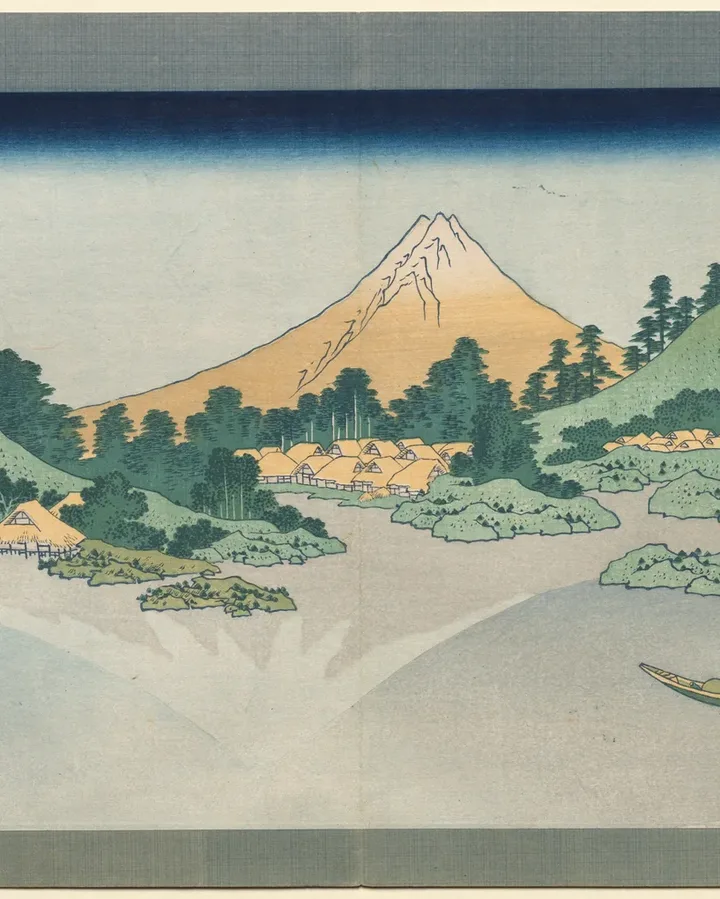
The Surface of Lake Misaka in Kai Province (Cleveland 1985.325) shows Fuji across still water, with its reflection in the lake below; as the Cleveland Museum of Art notes, the mountain is reflected in the clear water. The Cleveland impression measures 25.6 x 37.6 cm and is signed Zen Hokusai Iitsu hitsu, meaning brush of Iitsu, formerly Hokusai, with the publisher Nishimuraya Yohachi. It passed through the Louis Black sale at Sotheby Parke Bernet in 1976 before entering the Kelvin Smith Collection.
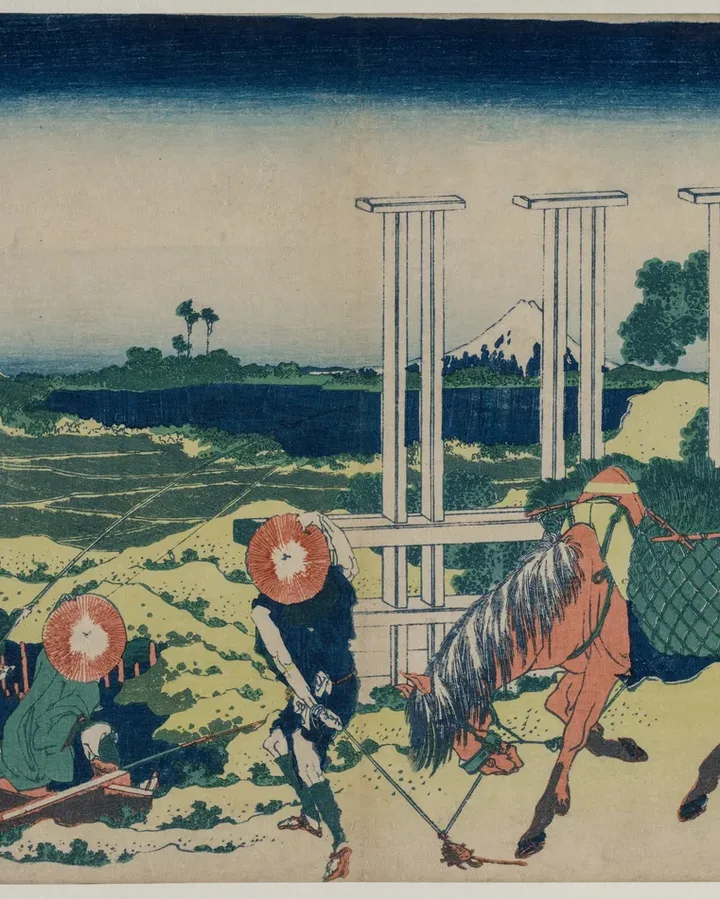
The Weir at Senju in Musashi Province (Cleveland 1924.964) shows a riverbank with a tall wooden weir, a man leading a laden horse and two figures fishing, while Fuji sits small and white on the horizon: the kind of everyday scene that makes up much of the series. It came to the museum in 1924 as a gift of Mrs. Francis F. Prentiss.
Why the series became famous
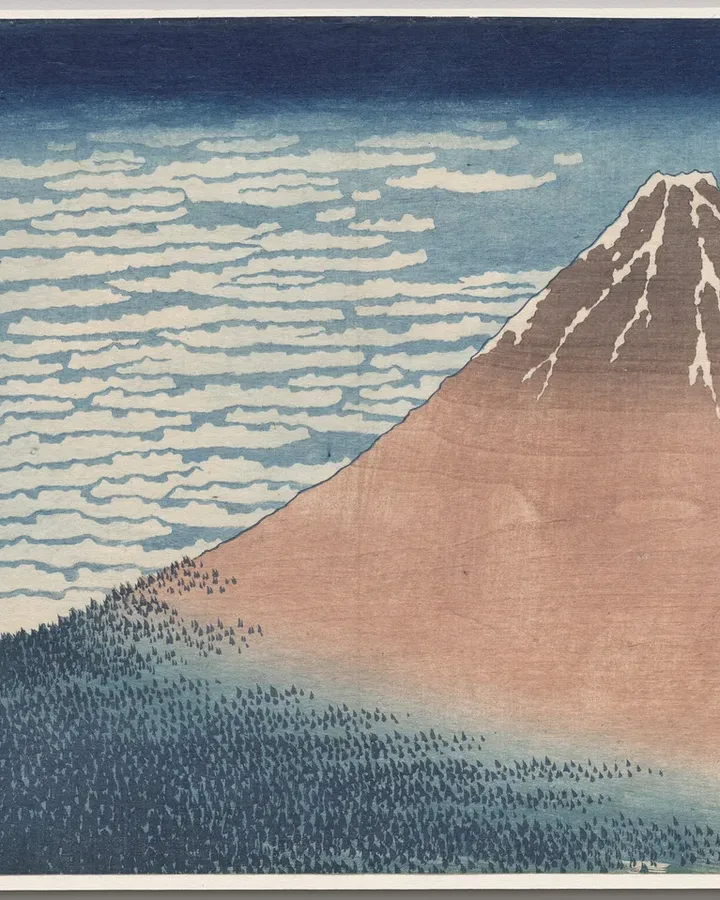
Thirty-Six Views is often called Hokusai's greatest color-print achievement, and it helped make landscape a major subject of Japanese prints; Hiroshige's Tōkaidō series followed soon after. Three of its designs are especially celebrated: The Great Wave off Kanagawa, Fine Wind, Clear Morning (Red Fuji) and Thunderstorm Beneath the Summit. The Great Wave is not in this archive; Red Fuji is, and has its own page.
In the late nineteenth century the series became well known in Europe. The French critic Edmond de Goncourt wrote in 1896 that it inspired the landscapes of the Impressionists, and the artist Henri Rivière later published Thirty-Six Views of the Eiffel Tower in homage. Reference sources estimate that fewer than ten complete sets survive.
Other versions in the archive
Frequently asked questions
How many prints are in Hokusai's Thirty-Six Views of Mount Fuji?
Forty-six. The original thirty-six designs were so popular that the publisher added ten more.
When was Thirty-Six Views of Mount Fuji made?
Around 1830 to 1832, when Hokusai was in his seventies. It was published by Nishimuraya Yohachi in Edo.
What are the most famous prints in the series?
The Great Wave off Kanagawa, Fine Wind, Clear Morning (Red Fuji) and Thunderstorm Beneath the Summit (Black Fuji). This archive holds Red Fuji and Thunderstorm Beneath the Summit, which Cleveland titles Rain Below the Mountain.
Is the Great Wave in this archive?
No. The archive holds other prints from the series, but not an impression of the Great Wave.
What is Black Fuji?
A nickname for Thunderstorm Beneath the Summit (Sanka hakuu), in which the base of Mount Fuji is dark with storm clouds and lightning while the peak stays clear.
Sources
- Cleveland Museum of Art, Rain Below the Mountain, 1940.1002
- Cleveland Museum of Art, The Surface of Lake Misaka in Kai Province, 1985.325
- Cleveland Museum of Art, The Weir at Senju in Musashi Province, 1924.964
- Wikipedia, Thirty-six Views of Mount Fuji
- Wikipedia, Thunderstorm Beneath the Summit
- Victoria and Albert Museum, Clear Day with a Southern Breeze (Gaifū kaisei)