Sharaku's Kabuki Actor Prints (1794) (1794)
Tōshūsai Sharaku is the most mysterious name in Japanese printmaking: an artist active for only about ten months in 1794 and 1795, whose real identity is unknown, and whose close-up portraits of kabuki actors are now among the most admired of all ukiyo-e. This page covers his work through the three Sharaku prints this archive holds, led by his portrait of Ichikawa Ebizō as Takemura Sadanoshin.
- Artist
- Tōshūsai Sharaku (active 1794–95); real name and life dates unknown
- Date
- 1794 (all three prints in this archive)
- Publisher
- Tsutaya Jūzaburō, whose emblem appears on all three
- Medium
- Color woodblock prints, ōban format
- Main print
- Ichikawa Ebizō IV as Takemura Sadanoshin, Cleveland Museum of Art 1930.205, 36 x 23.6 cm
- Also in this archive
- Matsumoto Kōshirō IV as Gorobei (1974.78) and Ōtani Tokuji I as Sodesuke (1930.206)
- Also known as
- Ichikawa Ebizō as Takemura Sadanoshin; Tōshūsai Sharaku actor portraits; Sharaku ōkubi-e; Matsumoto Kōshirō IV as Gorobei the Fish Seller
An artist who appeared and vanished
Prints signed Tōshūsai Sharaku began to appear in the fifth month of 1794 and stopped early in 1795. In that short span he designed around 140 to 150 prints, almost all of them pictures of kabuki actors in their roles; sources give slightly different totals, such as 144 known portraits or about 150 designs. Nothing reliable is known of his life. Researchers have proposed dozens of identities, including a Noh actor in the service of the lord of Awa Province, but none has won general acceptance.
His first and best-known group consisted of 28 large bust portraits, called ōkubi-e or large-head pictures, published by Tsutaya Jūzaburō, the same publisher who promoted Utamaro. These show actors from plays staged at three Edo theaters in the fifth month of 1794, set against dark backgrounds dusted with mica. Later groups were smaller, more crowded and, in most critics' view, weaker.
Ichikawa Ebizō as Takemura Sadanoshin
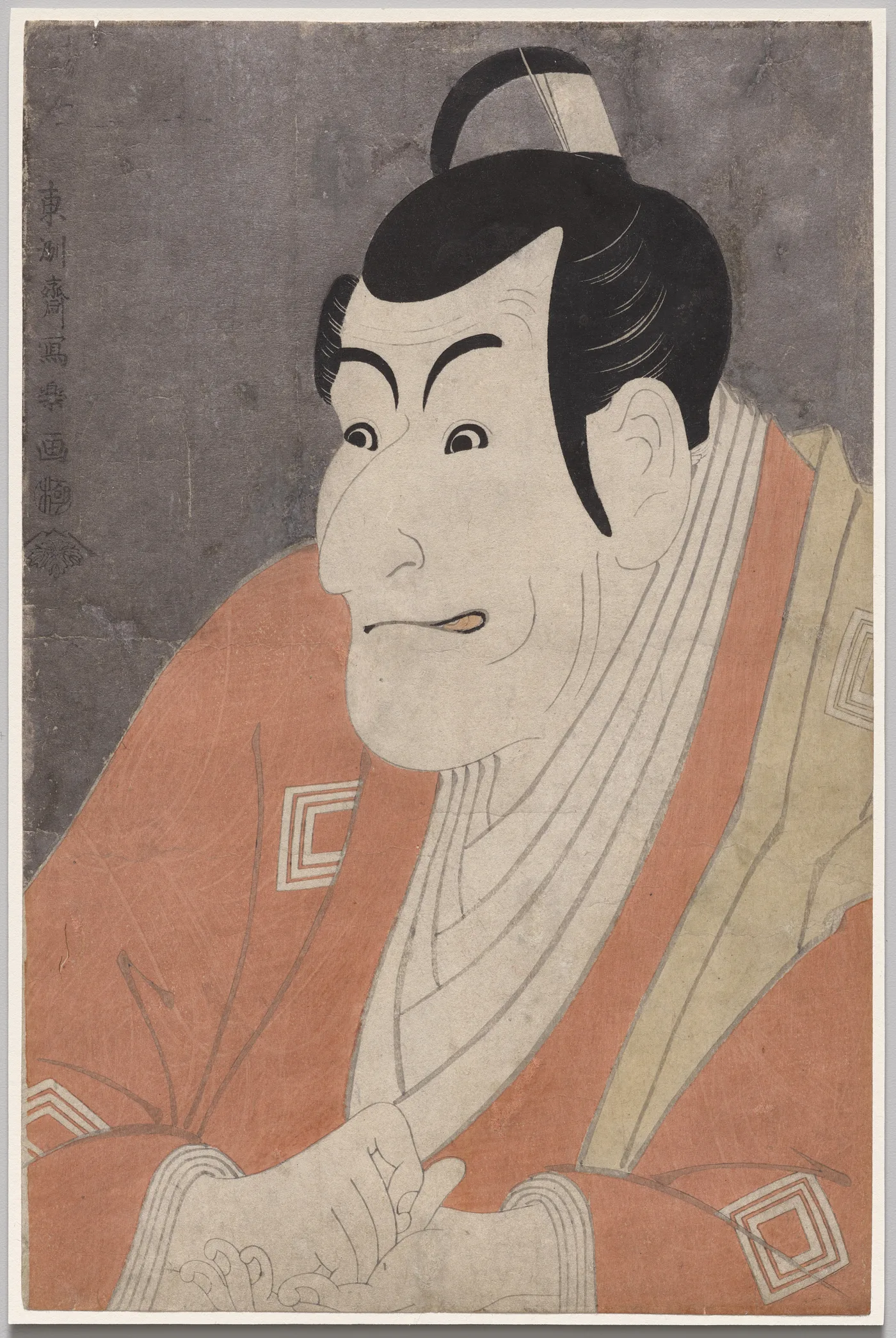
The archive's main Sharaku print shows Ichikawa Ebizō IV (1741–1806), one of the most celebrated actors of his time, who had earlier performed under the great stage name Ichikawa Danjūrō V. Here he plays Takemura Sadanoshin, a Noh performer, in The Loving Wife's Parti-Colored Reins (Koi nyōbō somewake tazuna), staged at the Kawarazaki theater in the fifth month of 1794. The Cleveland Museum of Art explains the scene: Sadanoshin is allowed to perform opposite his daughter so that he can see and hear her one last time before she is banished for a forbidden love affair.
Sharaku crops the actor to head, shoulders and clasped hands. The face is long and heavy, with a large hooked nose, raised brows and a tight, downturned mouth. The robe is a broad field of soft red-orange, and on it, as Cleveland points out, is the Ichikawa family crest of three nested squares, which told any theatergoer who this was.
Why Sharaku's portraits became famous
Earlier actor prints mostly used stock faces and poses. Sharaku went further than anyone toward likeness, and did not flatter: he showed big noses, heavy jaws and the lines of aging actors, and exaggerated expressions and gestures at a moment of high drama. A contemporary writer, Ōta Nanpo, is reported to have said that Sharaku drew too truthfully and so did not last long. The public apparently preferred idealized stars, and Sharaku's output stopped.
Later collectors and critics came to see exactly that frankness as his strength. Today the first-period bust portraits, such as the Ebizō, are counted among the masterpieces of ukiyo-e, and the puzzle of who Sharaku was keeps public interest in them alive.
The other two Sharaku prints in this archive
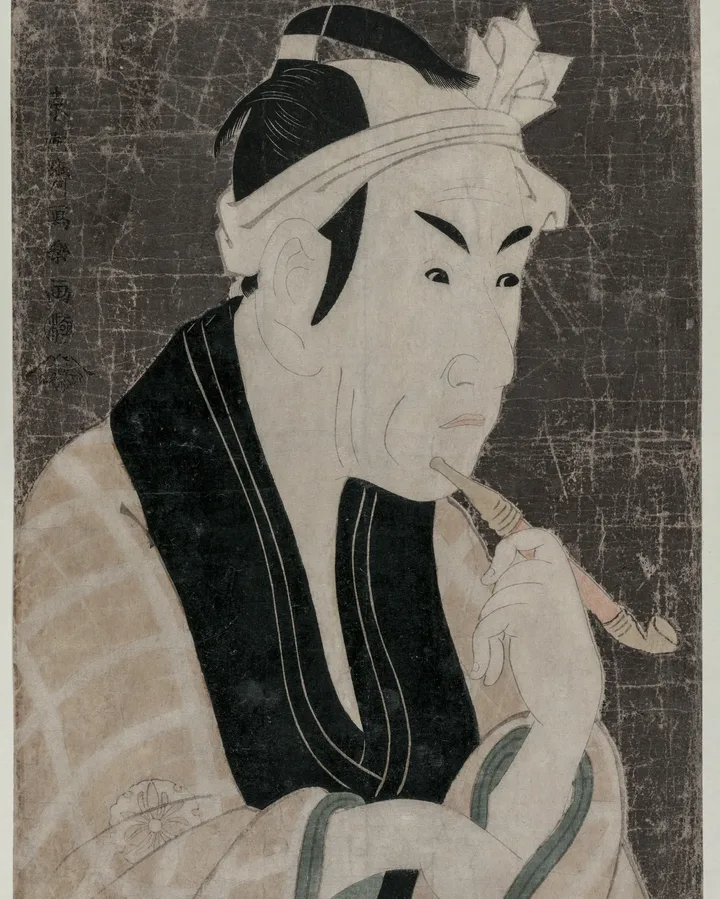
Matsumoto Kōshirō IV as Gorobei, the Fish Seller from Sanya (Cleveland 1974.78) comes from the same first group. The Cleveland Museum of Art records that it shows the actor as a fish merchant who helps two courtesan sisters avenge their father's murder, in the play A Medley of Tales of Revenge at the Kiri theater, and that Sharaku portrayed seven actors from that production. In the image Kōshirō, his head wrapped in a white cloth, holds a long pipe up near his chin.
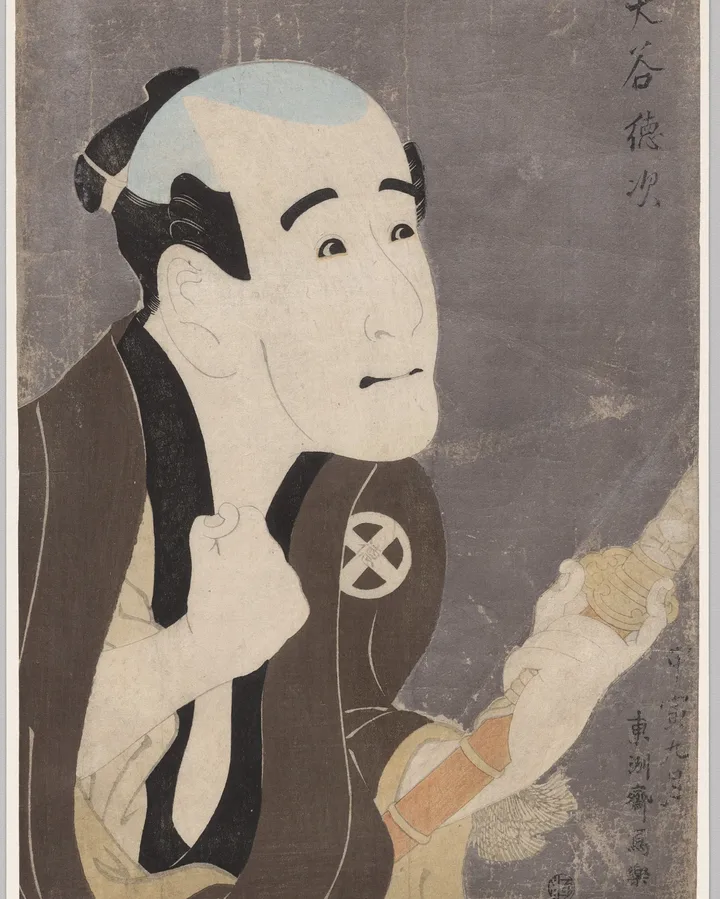
Ōtani Tokuji I as the Retainer Sodesuke (Cleveland 1930.206) shows a comic servant in Flowering Irises: A Soga Vendetta of the Bunroku Era, a play about two brothers hunting the man who murdered their father and older brother. Cleveland notes that the clenched fist and mouth express the character's determination.
What to look for in these impressions
All three Cleveland impressions carry the signature Tōshūsai Sharaku ga, the emblem of the publisher Tsutaya Jūzaburō and the censorship seal kiwame, which shows the design had been approved for sale. The Ebizō measures 36 x 23.6 cm; the Tokuji 36.2 x 25.2 cm; the Kōshirō 38.4 x 25.1 cm.
In the Ebizō and Tokuji images the background is a dark, slightly mottled grey. In first-period Sharaku portraits this ground was made with mica; Cleveland's records do not describe the material on these particular sheets, so we note only what the images show. The Ebizō and Tokuji prints came to the museum in 1930 from the collector Edward L. Whittemore, who bought them through Yamanaka and Co.; the Kōshirō was given by Jeptha H. Wade in 1974. Note that a different print in this archive titled The Actor Onoe Matsusuke is by Katsukawa Shunshō, an older master of actor prints, not by Sharaku.
Other versions in the archive
Frequently asked questions
Who was Sharaku?
Tōshūsai Sharaku was a Japanese print designer active for about ten months in 1794 and 1795. His real name and his birth and death dates are unknown, and more than fifty theories about his identity have been proposed without agreement.
How many prints did Sharaku make?
Sources give a little over 140 to about 150 prints, made between the fifth month of 1794 and the first month of 1795. Twenty-eight large bust portraits from 1794 are the most famous.
Who is the actor in Sharaku's portrait of Ichikawa Ebizō?
Ichikawa Ebizō IV (1741–1806), who earlier acted as Ichikawa Danjūrō V. Sharaku shows him as Takemura Sadanoshin in The Loving Wife's Parti-Colored Reins, staged in 1794.
Why do Sharaku's actors look so exaggerated?
Sharaku emphasized the actors' real features and the intensity of their stage expressions instead of idealizing them. Contemporaries found this too realistic, but later critics prized it.
Who published Sharaku's prints?
Tsutaya Jūzaburō, a leading Edo publisher who also worked with Utamaro. His emblem appears on all three Sharaku prints in this archive.
Sources
- Cleveland Museum of Art, Ichikawa Ebizō IV (Danjurō) as Takemura Sadanoshin, 1930.205
- Cleveland Museum of Art, Matsumoto Koshiro IV as Gorobei, the Fish Seller from Sanya, 1974.78
- Cleveland Museum of Art, Otani Tokuji I as the Retainer Sodesuke, 1930.206
- Wikipedia, Sharaku
- Tokyo Fuji Art Museum, Ichikawa Ebizo as Takemura Sadanoshin
- Wikipedia, Ichikawa Danjūrō V